








Quick Answer
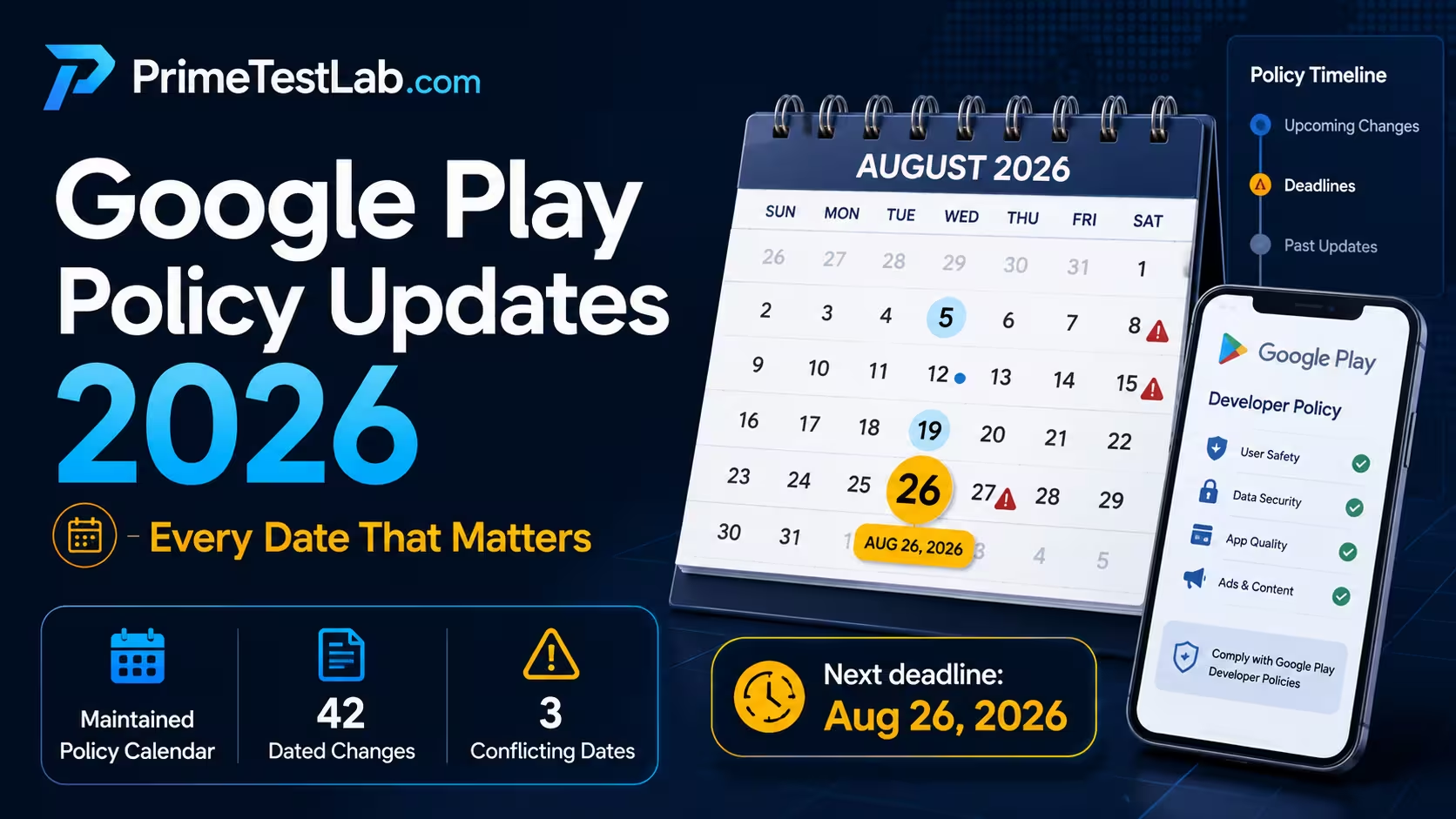
As of August 14, 2026, the confirmed Google Play policy deadlines still ahead are November 1 for the target API extension cutoff. Google's two current deadline pages now agree that Contacts and Location take effect on January 27, 2027; the Android Developers timeline listed October 28, 2026 for both until mid-August 2026, so that date is superseded rather than wrong. One conflict is still open: Child Safety Standards is August 26, 2026 on Play Console Help and October 28, 2026 on Android Developers, so prepare for August 26. Three dates that still rank in search results are dead: November 1, 2025 and May 31, 2026 for 16 KB page sizes, now February 1, 2027, and October 28 for Contacts. If one of these deadlines lands while you are mid closed test, PrimeTestLab holds the tester side steady while you ship the fix.
Nothing on this page is hard to find. It is hard to assemble. Google splits 2026 across a policy announcements page, a live deadlines table that quietly archives anything older than roughly three months, a policy archive, and a separate Android Developers timeline that is still out of step with the first one on one row. The result is that two developers can both read a Google page today and come away with different deadlines for the same policy. This register puts every dated change in one place, states who it applies to and the single action it asks for, and labels each row with a status so a disputed date never looks like a settled one. It is current as of August 14, 2026, and where Google contradicts itself, both dates and both URLs are printed rather than one being quietly chosen.
Updated August 14, 2026
Google's two current deadline pages now agree that Contacts and Location take effect January 27, 2027. Until mid-August 2026 the Android Developers timeline gave October 28, 2026 for both, and this page carried them as disputed rows. Child Safety Standards remains disputed between August 26 and October 28. Full changelog
Four tools on this page
All four run in your browser against values you choose. Nothing is uploaded, no account is needed, and no request leaves the page.
Table of contents
What Google Play Deadlines Are Left in 2026?
The next confirmed date is November 1, 2026, 16 days away. 41 rows are tracked below, from January 1, 2026 to September 30, 2027. 1 of them carries conflicting dates across 1 row: Google publishes two different dates for the Child Safety Standards expansion, so that row prints both. Filter the register to your own app first, because most of these rows will not apply to you.
What the 41 is counting
That total is this page's taxonomy rather than a figure Google publishes, so it is worth stating what goes into it: 22 policy effective dates, 1 row where two current Google pages give two different dates, 7 announcement and clarification dates that enforce nothing on their own, 10 Play commercial and program milestones that are not Developer Program Policy requirements at all, and 1 period Google has named without dating. Count announcements and program dates out and the number drops; count a disputed policy twice and it rises. Any article quoting a round number of "2026 Play policy changes" is quoting its own taxonomy too.
How to read each row
A single "deadline" label would flatten several different things into one: announcement dates that enforce nothing, clarifications that change nothing, dates that have since moved, and dates two Google pages disagree about. Each row carries a status instead.
-
Confirmed
One dated Google page, no contradiction found on 2026-08-12.
-
Sources differ
Two current Google pages give two different dates. Build for the earlier one.
-
Partial
The rule is documented; the exact original effective date is no longer exposed on a live Google page.
-
Announcement
An announcement or notice date, not an enforcement date. Individual effective dates vary.
-
Clarification
Google described this as a clarification of an existing rule. No new effective date.
-
Superseded
A real Google date that has since been replaced. Kept because it still circulates.
-
No date yet
Google has named a period but not a date. Anything more precise is speculation.
-
Program
A Play commercial or program milestone, not a Developer Program Policy requirement. It carries a real date and a real consequence, but missing one is a contractual or revenue matter rather than a policy violation. 10 rows carry this marker.
Google's live policy deadlines table keeps recent rows and moves older ones into a policy archive, so a deadline you were warned about in February can be genuinely hard to find by August. That is why the passed rows on this page are kept rather than deleted: developers keep receiving notices and rejection emails that cite them.
Build your own deadline list
Tick everything that describes the app you are shipping. The register below shrinks to the rows that can actually apply to you, and the summary tells you which of them is closest. Nothing is sent anywhere; the answers stay in this browser.
Instrument 02
Deadline profiler
Nothing ticked yet, so the register below is showing all 41 rows.
The profiler filters this page's rows. It is not a compliance audit, it cannot see your manifest or your Play Console, and a row it hides can still apply if your app does something the questions above do not ask about. 11 rows are tied to categories these questions do not cover and are never filtered in by a tick: Play business model changes announced; News and magazine self-declaration; Prediction-market pilot compliance; US Play Catalog sharing notice; "New install" classification date for Play service fees; Standard policy numbering starts rolling out; Play Catalog Access and US third-party app-store programs in effect; Service fee changes reach Australia and Japan; New Apps and Games program becomes available; Service fee changes and the new program reach Korea; Service fee changes and the new program reach the rest of the world.
The full 2026 and early 2027 register
Verified against Google's live pages on August 14, 2026. Every row names its own primary source, and every date is written out in full so it can be quoted without inference.
-
Jan 1, 2026 Age Signals API data-use restriction Confirmed Passed
-
Jan 28, 2026 US external-content links and alternative-billing program requirements Program Confirmed Passed
-
Jan 28, 2026 India personal-loan RBI list requirement for existing apps Confirmed Passed
-
Jan 28, 2026 New 180-day limit on developer-account termination appeals Confirmed Passed
-
Jan 28, 2026 Original age-restricted rule for matchmaking, dating and real-money features Partial Passed
-
Jan 28, 2026 Thailand personal-loan listing update announced Announcement Passed
-
Mar 4, 2026 Play business model changes announced Program Announcement Passed
-
Mar 4, 2026 Thailand personal-loan listing deadline for existing apps Confirmed Passed
-
Apr 15, 2026 April Developer Program Policy batch Announcement Passed
-
May 27, 2026 Account Transfer policy Confirmed Passed
-
May 27, 2026 News and magazine self-declaration Confirmed Passed
-
Jun 1, 2026 Prediction-market pilot compliance Confirmed Passed
-
Jun 22, 2026 US Play Catalog sharing notice Program Announcement Passed
-
Jun 30, 2026 "New install" classification date for Play service fees Program Confirmed Passed
-
Jul 15, 2026 July Developer Program Policy batch Announcement Passed
-
Jul 15, 2026 Content rating wording for unrated apps Clarification Passed
-
Jul 15, 2026 User Data requirements apply to third-party AI integrations Clarification Passed
-
Jul 15, 2026 Precise and approximate location treatment in Data Safety Clarification Passed
-
Jul 15, 2026 Standard policy numbering starts rolling out Announcement Passed
-
Jul 22, 2026 Play Catalog Access and US third-party app-store programs in effect Program Confirmed Passed
-
Jul 27, 2026 One-time appeal window for accounts terminated before January 28, 2026 Confirmed Passed
-
Aug 1, 2026 Android TV quality: 32-bit and 64-bit architectures plus 16 KB page sizes Confirmed Passed
-
Aug 26, 2026 Age-Restricted Content and Functionality expands to random and anonymous chat Confirmed Passed
-
Aug 26, 2026 Families policy prohibits anonymous-chat apps targeting children Confirmed Passed
-
Aug 26, 2026 Child Safety Standards expands to anonymous and random chat Sources differ Passed
-
Aug 26, 2026 Geofencing removed as an approved foreground-service use case Confirmed Passed
-
Aug 31, 2026 Target API level for new apps and app updates Confirmed Passed
-
Aug 31, 2026 Existing-app availability threshold Confirmed Passed
-
Sep 30, 2026 Google Play package-name registration Confirmed Passed
-
Sep 30, 2026 Android developer verification, first installation enforcement Confirmed Passed
-
Sep 30, 2026 Service fee changes reach Australia and Japan Program Confirmed Passed
-
Sep 30, 2026 New Apps and Games program becomes available Program Confirmed Passed
-
Oct 1, 2026 US transaction reporting and applicable service fees Program Confirmed Passed
-
Nov 1, 2026 Target API extension cutoff Confirmed 16 days
-
Dec 31, 2026 Service fee changes and the new program reach Korea Program Confirmed 76 days
-
Jan 27, 2027 SMS and Call Log: the phone-call verification exception ends Confirmed 103 days
-
Jan 27, 2027 Contacts Permissions policy Confirmed 103 days
-
Jan 27, 2027 Location Permissions policy Confirmed 103 days
-
Feb 1, 2027 16 KB page-size compatibility enforcement Confirmed 108 days
-
Sep 30, 2027 Service fee changes and the new program reach the rest of the world Program Confirmed 349 days
-
2027 and beyond Global Android developer-verification expansion No date yet No date
No row matches that combination. Clear a filter to see the rest.
This calendar includes Google-announced dates known as of August 14, 2026. Further 2026 changes will be added when Google announces them. No dated Developer Program Policy change had been announced for September through December 2026 beyond the rows above when those pages were last read, and that is a statement about what Google had published by then, not a prediction that the rest of the year is empty.
Play program dates, which are not policy deadlines
These 10 rows appear in the register above with a Program marker, and they are collected here because mixing them into policy enforcement is how a fee-classification date ends up in someone's compliance plan. They are real, dated and sourced. None of them is a Developer Program Policy requirement, and missing one is a commercial or contractual problem rather than a policy violation. Most of them are Google's staged business-model rollout, which reaches different markets on different dates across 2026 and 2027, so the date that matters to you depends on where you earn.
- January 28, 2026 US external-content links and alternative-billing program requirements Developers serving US users who want to stay in those programs.
- March 4, 2026 Play business model changes announced Every developer earning money through Google Play, eventually. The rollout is staged by region across 2026 and 2027.
- June 22, 2026 US Play Catalog sharing notice Developers whose Play listings may be supplied to participating third-party US Android stores.
- June 30, 2026 "New install" classification date for Play service fees Developers earning through Play on EEA, UK and US transactions. This is a commercial classification, not a policy requirement.
- July 22, 2026 Play Catalog Access and US third-party app-store programs in effect Participating US app stores and Play developers whose listings are in scope.
- September 30, 2026 Service fee changes reach Australia and Japan Developers earning through Play on Australian and Japanese transactions.
- September 30, 2026 New Apps and Games program becomes available Developers in Australia, the EEA, Japan, the UK and the US.
- October 1, 2026 US transaction reporting and applicable service fees Developers enrolled in the affected US external-content-links and alternative-billing programs.
- December 31, 2026 Service fee changes and the new program reach Korea Developers earning through Play on Korean transactions.
- September 30, 2027 Service fee changes and the new program reach the rest of the world Every remaining Play market not covered by the earlier waves.
The June 30 row is the one most often left out of a "2026 Play changes" list entirely. It does not ask you to change anything in the app: it is the line Google draws between a "new install" and an existing one, and which side a user falls on determines the service-fee rate applied to their transactions on EEA, UK and US activity. It belongs on a finance model, not on an engineering sprint.
Why Do Google's Own Pages Give Different Dates?
Because Google maintains the same information in more than one place, and the two places are not always edited on the same day. The Play Console Help policy deadlines table and the Android Developers policy timeline are both current and both official. Through early August 2026 they gave different effective dates for three policies. Two of those disagreements have since closed: Android Developers moved Contacts Permissions and Location Permissions from October 28, 2026 to January 27, 2027, which is the date Play Console Help had all along. One is still open: the Child Safety Standards expansion is August 26, 2026 on Play Console Help and October 28, 2026 on Android Developers. Build for August 26.
This is not a minor documentation wrinkle. It was the difference between shipping a permissions change in October and shipping it in January, and it is the reason a search result, an assistant answer and a colleague can all quote a different date for the same policy while all three are reading Google.
Watch what the resolution looked like from outside: no announcement, no changelog entry, no note on either page saying which date had been wrong. One surface was quietly edited to match the other, and any article that had picked October 28 and moved on became inaccurate that day without its author touching it. That is the actual risk in this topic, and it is why the rows below keep the superseded date in view instead of deleting it.
There is a second layer to it. On August 14, 2026, the Play Console Help deadlines page returned January 27, 2027 in its body while the indexed search snippet for that same URL still carried the older October 28, 2026 wording. So a reader could search, see Google's own domain in the result, read October 28 in the snippet, and never open the page that said something else. Stale snippets of live pages are part of the problem, not just stale blog posts.
Instrument 03
Conflict switcher
Showing the dates published on Play Console Help, the policy deadlines table. support.google.com, table 12921780
-
Contacts Permissions
January 27, 2027
Both pages now agree. Android Developers previously published
October 28, 2026Settled on January 27, 2027 -
Location Permissions
January 27, 2027
Both pages now agree. Android Developers previously published
October 28, 2026Settled on January 27, 2027 -
Child Safety Standards expansion
August 26, 2026
Other page:
October 28, 2026Build for August 26, 2026
1 live conflict, 2 resolved. Both pages were re-read on August 14, 2026. Where they still differ, this page shows both dates and recommends preparing for the earlier one; it does not decide which page is right, because nothing on either page says one supersedes the other, and the verdict line is a risk position rather than a Google statement. Where they now agree, the date Google replaced is kept visible so a reader arriving with the old one can tell it was real.
What was never in dispute
The dates moved. The scope did not, and the scope is what determines whether any of this is your problem. Google's Contacts guidance ties the new broad-contacts regime to the apps it applies to rather than to the calendar, and that sentence has been stable on both surfaces throughout.
Android 17 or later (API level 37+)
Google Play Console Help, answer 16909972, on the apps the Contacts Permissions policy applies toSo an app that does not target API 37 is not inside the broad-contacts regime yet, and an app that only ever needs one user-chosen contact is pointed at Android Contact Picker rather than at broad access. The same logic applies to the Child Safety row, the one still in dispute: the definition of a random or anonymous chat app is stable across both pages, and only the date differs. If you scoped your work off the definition rather than off the date, the October-to-January move cost you nothing.
How to read a Google deadline page
- Open the page and read the body. A search snippet can be months behind the page it points at.
- Check both surfaces: the Play Console Help deadlines table and the Android Developers policy timeline.
- Plan engineering against the earlier date and communicate the later one as unresolved.
- Write down the date you read and the day you read it. That is the only way you will notice a silent edit.
- Treating the first Google-domain result you see as settled because the domain is right.
- Assuming the later of two dates applies because it is more comfortable.
- Deleting an old date once it moves. You will need it when someone quotes it back to you.
- Reading "at least 30 days to comply" as the effective date. It is a floor on notice, not a date.
The status of these rows can change any week
August 26 has passed, so the Child Safety row should be re-checked against the final policy page rather than the preview wording, and against the October 28 date the Android Developers timeline still carries for it.
What Changes on August 26, 2026?
Four things, and only one of them is about chat features you might think you do not have. Google's Age-Restricted Content and Functionality policy expands to apps whose core functionality randomly connects strangers or hides who a user is; the Families policy stops anonymous-chat apps from targeting children; the Child Safety Standards expansion is dated here by Play Console Help and October 28 by Android Developers, making it the only date on this page Google still contradicts itself on; and geofencing stops being an approved foreground-service use case. If none of those four describes your app, August 26 is not your date.
August 26, 2026
Passed-
Confirmed
Age-Restricted Content and Functionality expands to random and anonymous chat
Who Apps whose core functionality randomly connects strangers or deliberately hides who a user is.
Do Use Play Console functionality and tools to prevent minors from accessing the app.
-
Confirmed
Families policy prohibits anonymous-chat apps targeting children
Who Anonymous-chat apps that target children.
Do Stop targeting children, or change the product so the anonymous-chat characterisation no longer applies.
-
Sources differ
Child Safety Standards expands to anonymous and random chat
Who Random and anonymous chat apps.
Do Prepare for the earlier of the two published dates, which is August 26.
-
Confirmed
Geofencing removed as an approved foreground-service use case
Who Apps that declare a foreground service for geofencing.
Do Move the use case to the Geofence API.
Anonymous and random chat apps
The trigger is core functionality, not the presence of a chat screen. Google's policy preview language is specific about the date.
effective August 26, 2026
Google Play Console Help, answer 17036597, Age-Restricted Content and FunctionalityThe apps in scope are the ones whose core functionality randomly connects strangers or deliberately conceals user identity. For those, the requirement is to use the functionality and tools Google provides in Play Console to prevent minors from accessing the app. A messaging feature inside a delivery app, a support chat, or a comment thread is not what this policy is aimed at.
The word that causes the most confusion is "matchmaking." It appears in the same policy family and it does not mean what a game developer reads it as meaning. Google's language focuses on apps whose core functionality facilitates matchmaking or dating, and it treats incidental matchmaking or dating features differently when effective safeguards keep minors away from those features. A multiplayer game with a matchmaking queue is not automatically classified alongside a dating app.
The honest test to run on your own app
Ask whether a reasonable person describing your app in one sentence would mention connecting strangers or hiding identity. If they would, treat yourself as in scope and use the Play Console tools. If they would not, document why the feature is incidental and what stops a minor from reaching it, because that is the argument you will need if the classification is ever questioned. Google does not publish a self-certification form for this, so the reasoning is yours to record.
Why Google gives two dates for Child Safety Standards
The Age-Restricted and Families rows above are dated August 26 consistently. Child Safety Standards is not, and after Contacts and Location were reconciled in mid-August 2026 it is the last row on this page where Google's two surfaces still disagree. One dates the expansion here, another dates it two months later, and neither says it supersedes the other.
- Play Console Help says August 26, 2026 Policy deadlines table 12921780
- Android Developers says October 28, 2026 Google Play policies timeline
Prepare by the earlier date. The cost of being early is a few weeks of lead time; the cost of being late is enforcement against a live app. You can compare both surfaces row by row in the conflict switcher above.
Geofencing and foreground services
This is the row most likely to catch a team that has never read a child-safety policy in its life. Geofencing stops being an approved use case for a foreground service, and Google names the replacement directly.
use the Geofence API
Google Play Console Help, policy deadlines table 12921780If your foreground-service declaration rests on geofencing, the declaration is the thing that stops being defensible, so the work is to move the use case rather than to reword the form. Everything else about your foreground-service usage is unaffected by this row.
August 26 has passed. The rows above were written from Google's policy preview pages; once a policy is in force the preview wording is usually replaced, so re-read the live policy rather than a preview citation before relying on the exact phrasing.
What Changes on August 31, 2026?
The 2026 target API requirements, and they are two separate rules that get confused constantly. Rule one is a submission floor: from August 31, a new app or an app update has to target the level for its form factor, which is API 36 for mobile. Rule two is an availability floor for apps you never touch again, which is API 35 for mobile. Missing the first blocks your upload. Missing the second quietly stops new users on newer Android versions from seeing the app at all.
August 31, 2026
Passed-
Confirmed
Target API level for new apps and app updates
Who Every new app and every app update submitted to Google Play.
Do Mobile needs API 36. Wear OS and Android Automotive OS need API 35. Android XR needs API 34. Android TV also needs API 34, but that is not new: Google's form-factor table dates the TV requirement to August 31, 2025.
-
Confirmed
Existing-app availability threshold
Who Published apps below the availability level for their form factor, even if you never submit an update.
Do Raise the target to the applicable availability threshold. Mobile is API 35.
Starting August 31 2026
Android Developers, target API level requirements for Google Play appsThe two rules, kept apart
Nearly every wrong answer about this deadline comes from collapsing these into one number. They have different triggers and different consequences.
- If you submit anything API 36 for mobile New apps and updates both. Below the level for your form factor, the submission does not meet the requirement.
- If you submit nothing API 35 for mobile An app you never update stops being available to new users on devices running newer Android versions. It is not deleted, and people who already installed it keep it.
The level for each form factor
Do not copy the mobile number onto every build. The levels differ per form factor, and the availability column differs again.
| Form factor | New apps and updates | Availability floor | Note |
|---|---|---|---|
| Android mobile, tablets, foldables | API 36 | API 35 | The standard case. Both rules apply. |
| Android Auto | API 36 | API 35 | Google does not list Android Auto as its own form factor, because an Auto app is a phone app. The mobile requirement is the one that applies. |
| Wear OS | API 35 | API 34 | A separate build with a separate level. |
| Android Automotive OS | API 35 | API 32 | The lowest availability floor of any form factor. |
| Android TV | API 34 | API 33 | Not a 2026 increase: Google's form-factor table dates the API 34 submission rule to August 31, 2025. Also has the August 1 TV quality requirements. |
| Android XR | API 34 | API 34 | Submission and availability floors are the same level. |
One row in that table is not a 2026 change at all, and Google's own pages make it easy to misread. The Android Developers summary groups Android TV's API 34 requirement under August 31, 2026 alongside everything else, but the detailed Play Console Help form-factor table dates that submission requirement to August 31, 2025. If you ship a TV app, you have been under the API 34 rule for a year already and nothing changes for you on August 31, 2026. The number that does differ is the availability floor: an existing TV app that is never updated stays compliant at API 33, one level below the submission requirement, and it is apps at API 32 or lower that lose availability to new users on newer Android versions.
The availability floor works as a ceiling on reach, not as a switch: an app below it stays available only on devices running an Android version the same as or lower than what the app targets. Raising targetSdk does not raise minSdk, so meeting this deadline does not drop older devices from your install base. Permanently private apps distributed only inside an organisation are exempt. The full migration walkthrough, including the Play Console screens and the behaviour changes that come with each level, is in the target API 36 post.
Can I extend the August 31 deadline?
Sometimes. Google's 2026 target-level guidance provides eligible affected developers with extra time through November 1, 2026, requested through the Play Console notification supplied to affected developers. Three things to be clear about before you plan around it.
- It is requested, not automatic. There is no guarantee every account or every app sees the option.
- It does not create a lower target level. The same level is still required; you get more time to reach it.
- The window closes on November 1, 2026, which is itself a row on this calendar.
Google has a separate flow for requesting more time on certain policy declarations, surfaced in Play Console against the specific declaration it applies to. Console navigation changes on its own schedule, so follow the notification Google shows for that deadline rather than a menu path written down in an article, including this one. And do not read the existence of one extension as evidence that every deadline on this page can be extended: most of the rows here have no extension mechanism documented at all.
What Changes on September 30, 2026?
Two requirements that are constantly reported as one. The first is Google Play package-name registration, which applies to Play apps globally and where Google warns of removal from Play. The second is the first enforcement wave of Android developer verification, which applies to installs through participating stores in four countries: Brazil, Indonesia, Singapore and Thailand. Same date, different scope, different consequence. Neither is a worldwide switch-off of unverified Android apps. Two commercial items land on the same day and are not policy requirements at all: service-fee changes reaching Australia and Japan, and the new Apps and Games program becoming available in five markets.
September 30, 2026
Passed-
Confirmed
Google Play package-name registration
Who Play apps that Google did not register automatically. Google says over 99% were.
Do Open Play Console Home and register any package name still showing as unregistered.
-
Confirmed
Android developer verification, first installation enforcement
Who Apps installed through participating stores in Brazil, Indonesia, Singapore and Thailand, on certified Android devices.
Do Verify as a developer and register the app or package as required.
-
Confirmed
Service fee changes reach Australia and Japan
Who Developers earning through Play on Australian and Japanese transactions.
Do Re-model your fee assumptions for those two markets from this date.
-
Confirmed
New Apps and Games program becomes available
Who Developers in Australia, the EEA, Japan, the UK and the US.
Do Decide whether the new program suits your business. Availability is not enrolment.
The two requirements that actually need action
Of the four rows above, these are the two that can cost you something if you ignore them. The other two are the commercial rollout reaching new markets, and they ask nothing of your app.
Requirement A
Google Play package-name registration
- Scope
- Every Google Play app. Google says more than 99% were registered automatically.
- Your action
- Open Play Console Home and check the registration status. Register anything Google did not pick up.
- If you do nothing
- Google warns of global removal from Play and installation problems.
Requirement B
Android developer verification, wave one
- Scope
- Installs through participating stores in Brazil, Indonesia, Singapore and Thailand, on certified Android devices.
- Your action
- Complete developer verification and register the app or package as required.
- If you do nothing
- An unverified or unregistered app cannot follow the ordinary participating-store install and update path on in-scope devices.
register their app package names
Google Play Console Help, policy deadlines table 12921780The "over 99% were registered automatically" figure is the reason this row gets ignored, and it is also the reason it is worth two minutes of your time. If you are in the remaining fraction, the documented consequence is not a warning banner, it is removal. Checking costs one page load in Play Console.
Is September 30 a worldwide Android ban?
No. Enforcement starts in four countries, and on wider expansion Google publishes a period rather than a date.
2027 and beyond
Android Developers, developer verification overview, on wider expansionThat is the whole published commitment. As of August 14, 2026 there is no announced worldwide enforcement date, so any article naming one is inferring. Verifying early is still the cheap move, because it is not something you want to discover you need during a release. And the "sideloading is dead" reading survives only if you never open Google's own FAQ: four things stay open, and they are the difference between a blocked release and a mild inconvenience.
-
ADB installs
Unaffected. Google says you are free to install apps without verification over ADB, so that developers can build and test apps not yet meant for wider distribution.
Your own debug loop and anything you hand a tester over a cable is untouched.
-
The advanced flow for experienced users
Google is introducing a one-time setup that lets a user accept the risk and install apps from unverified developers, behind developer mode, a restart, a waiting period and a biometric or PIN confirmation.
It exists, but it is deliberately slow. Do not design a distribution plan around asking ordinary users to walk through it.
-
Other stores and direct sideloading
Google says the September 30 deadline applies only to the participating stores. Distribution through other stores, or users sideloading your app directly, is not covered by this phase.
Check whether the store you actually use is on the participating list before assuming you are affected.
-
Form factors other than phones and tablets
Google says enforcement in this phase applies to mobile and tablet form factors in the selected regions, while recommending registration across form factors to future-proof availability.
Register anyway. The recommendation is cheap and the scope is expected to widen.
None of that makes the date ignorable. It means the honest framing is narrow: for in-scope apps distributed through participating stores in those four countries, the ordinary install and update path closes. Everything else Google has explicitly left open, and it says so on its verification FAQ.
Verification is not the closed testing requirement
These are separate hurdles and clearing one never clears the other. Developer verification is an identity layer for the Android ecosystem. The 12-tester, 14-day closed test is a Play Console gate for new personal developer accounts applying for production access. A verified developer with no completed closed test still cannot publish to production. The paperwork side is covered in the developer verification post, and what it does to a build you hand a tester is in the APK install post.
What Changes in October 2026?
One dated row, and it is commercial rather than technical: on October 1, developers enrolled in the affected US external-content-links and alternative-billing programs start reporting transactions and accounting for applicable service fees. If you are looking for October 28, it is no longer a Contacts or Location deadline. Google moved both to January 27, 2027 in mid-August 2026. It survives on one Google page as the Child Safety Standards date, which the other page puts on August 26.
October 1: reporting and fees in the affected US programs
October 1, 2026
Passed-
Confirmed
US transaction reporting and applicable service fees
Who Developers enrolled in the affected US external-content-links and alternative-billing programs.
Do Start the required reporting and account for the applicable service fees.
This row only reaches you if you enrolled in one of the US programs that let you link out to external content or offer alternative billing. If you did, reporting and any applicable service fees begin here, and the requirement is administrative rather than technical. If you did not enrol, nothing on this date applies to you.
Worth naming the category: this is a Program row, not a Developer Program Policy requirement. Missing it is a contractual and billing problem with Google rather than a policy violation against your app, and it cannot get your app removed the way a missed policy deadline can. The program dates are listed together under the register for that reason. It is the tail end of a sequence that started with the January 28 program requirements and ran through the June 22 catalog notice and the July 22 program start, all of which are in the passed rows.
October 28: what happened to it
For most of 2026 this was the headline date on this page. The Android Developers policy timeline listed Contacts Permissions and Location Permissions as effective October 28, 2026, while the Play Console Help deadlines table listed both as January 27, 2027. This page carried them as disputed rows and told you to engineer for October.
That disagreement closed in mid-August 2026. Android Developers now gives January 27, 2027 for both policies, matching Play Console Help. There was no announcement and no changelog entry; one page was edited to match the other. If you planned against October 28, you have not lost anything and you are three months early, which is the outcome the earlier-date rule is designed to produce. Both rows now sit in what is already set for 2027.
If an article or an assistant still tells you October 28
It is not wrong about where the date came from, only about whether it still stands. October 28 was published by Google, on a Google page, for months. The one place it remains current is the Android Developers entry for the Child Safety Standards expansion, which Play Console Help dates to August 26. So the question to ask a source quoting October 28 is which policy it means, and when it last checked.
What Is the November 1, 2026 Cutoff?
The end of the extension window for the August 31 target API requirement, and nothing else. It is not a second, later target level, it does not apply to anyone who did not request extra time, and it changes no other deadline on this page. If you never requested an extension, November 1 is not a date you need.
November 1, 2026
16 days away-
Confirmed
Target API extension cutoff
Who Apps that were granted extra time for the 2026 target API requirement.
Do Ship the compliant target-level build before the cutoff.
16 days out. If you hold an extension, the only thing that matters between now and then is a compliant build going live, because the extension buys time rather than lowering the level. If you do not hold one, this row is informational.
Why this gets its own row at all: search results and summaries regularly present November 1, 2026 as a target API deadline in its own right, which leads teams to believe they have until November when the submission floor arrived on August 31. One date is a requirement. The other is a grace period that not every account has. The detail of requesting it sits in the target API 36 post.
Which 2026 Deadlines Have Already Passed?
33 of the 41 tracked rows are behind us as of August 14, 2026. They are kept here rather than deleted, because Google's live deadlines table archives older rows and developers keep arriving with a Console warning, a rejection email or an article that cites one of them. A passed date still tells you whether what you are reading was ever true.
January 2026
- Jan 1 Age Signals API data-use restriction Confirmed
- Jan 28 US external-content links and alternative-billing program requirements Confirmed
- Jan 28 India personal-loan RBI list requirement for existing apps Confirmed
- Jan 28 New 180-day limit on developer-account termination appeals Confirmed
- Jan 28 Original age-restricted rule for matchmaking, dating and real-money features Partial
- Jan 28 Thailand personal-loan listing update announced Announcement
March 2026
- Mar 4 Play business model changes announced Announcement
- Mar 4 Thailand personal-loan listing deadline for existing apps Confirmed
April 2026
- Apr 15 April Developer Program Policy batch Announcement
May 2026
- May 27 Account Transfer policy Confirmed
- May 27 News and magazine self-declaration Confirmed
June 2026
- Jun 1 Prediction-market pilot compliance Confirmed
- Jun 22 US Play Catalog sharing notice Announcement
- Jun 30 "New install" classification date for Play service fees Confirmed
July 2026
- Jul 15 July Developer Program Policy batch Announcement
- Jul 15 Content rating wording for unrated apps Clarification
- Jul 15 User Data requirements apply to third-party AI integrations Clarification
- Jul 15 Precise and approximate location treatment in Data Safety Clarification
- Jul 15 Standard policy numbering starts rolling out Announcement
- Jul 22 Play Catalog Access and US third-party app-store programs in effect Confirmed
- Jul 27 One-time appeal window for accounts terminated before January 28, 2026 Confirmed
August 2026
- Aug 1 Android TV quality: 32-bit and 64-bit architectures plus 16 KB page sizes Confirmed
- Aug 26 Age-Restricted Content and Functionality expands to random and anonymous chat Confirmed
- Aug 26 Families policy prohibits anonymous-chat apps targeting children Confirmed
- Aug 26 Child Safety Standards expands to anonymous and random chat Sources differ
- Aug 26 Geofencing removed as an approved foreground-service use case Confirmed
- Aug 31 Target API level for new apps and app updates Confirmed
- Aug 31 Existing-app availability threshold Confirmed
September 2026
- Sep 30 Google Play package-name registration Confirmed
- Sep 30 Android developer verification, first installation enforcement Confirmed
- Sep 30 Service fee changes reach Australia and Japan Confirmed
- Sep 30 New Apps and Games program becomes available Confirmed
October 2026
- Oct 1 US transaction reporting and applicable service fees Confirmed
Open any of these rows in the register for who it applied to, the action it asked for and its primary source. Google's own policy archive carries official policy-version dates for January 1, January 28, March 4, April 15 and May 27, 2026, which is the place to look when you need the wording as it stood on a given day rather than the wording as it stands now.
Three things the passed rows teach you
One date can carry unrelated obligations. Five separate things landed on January 28, which is why that date turns up in so many unconnected warnings: US program requirements, the India personal-loan RBI list, the 180-day limit on termination appeals, the age-restricted matchmaking rule and the Thailand listing announcement. Only three are Developer Program Policy requirements. One of the five is marked Partial here, because Google's live table has aged the matchmaking row out and this page will not invent a clean effective date it can no longer point at.
An announcement date is not an enforcement date. April 15 and July 15 were announcement batches, and nothing became enforceable by virtue of being announced. Google gives at least 30 days to comply with newly updated policies unless it says otherwise, and "at least 30 days" is a floor on notice, not a date. Reading it as one is how a policy batch becomes a phantom deadline in a project plan.
Two rows could not be acted on late. Most passed deadlines still can be: you register the package, fix the listing, complete the declaration. The July 22 catalog opt-out closed as the program took effect, and the July 27 legacy appeal window for accounts terminated before January 28, 2026 ended outright. Community reports of an appeal form that redirected or refused to submit near that deadline are real, and they are not the same thing as an extension. Nothing in Google's documentation says the window moved, so this page does not say it either.
You have 180 days
Google Play Console Help, answer 16659089, on appealing a termination decision made on or after January 28, 2026What Is Already Set for 2027?
Two dates and one deliberately vague period. January 27, 2027 carries three rows: the end of the SMS and Call Log exception that allowed READ_CALL_LOG to confirm a verification phone call, plus the Contacts and Location permissions policies, which both Google surfaces now date here. February 1, 2027 is the current 16 KB page-size enforcement date. Beyond that, Android developer verification expands during "2027 and beyond", which is a period Google has published and a date it has not.
January 27, 2027
January 27, 2027
103 days away-
Confirmed
SMS and Call Log: the phone-call verification exception ends
Who Apps using READ_CALL_LOG only to confirm an incoming verification call.
Do Move to an approved alternative such as the Digital Credentials API or the SMS Retriever API.
-
Confirmed
Contacts Permissions policy
Who Apps targeting Android 17 (API level 37) or later that want broad access to the contacts list.
Do Decide whether broad access is genuinely core. If it is not, move to Android Contact Picker.
-
Confirmed
Location Permissions policy
Who Apps using precise location within the scope of the policy.
Do Prefer the minimum-scope approach, and the system location button where it applies.
The SMS and Call Log row is settled and narrow. If your only justification for READ_CALL_LOG is confirming that a verification call arrived, that justification stops being available, and the documented direction is an approved alternative such as the Digital Credentials API or the SMS Retriever API. Apps left without a compliant permission basis may be removed, and Google is explicit that undeclared deceptive use can draw stronger enforcement than a simple policy miss.
The Contacts and Location rows arrived here late. Until mid-August 2026 the Android Developers policy timeline dated both to October 28, 2026 while Play Console Help dated them here, and this page carried them as disputed. Android Developers has since moved both to January 27, 2027, so the two surfaces agree and the date is settled. Do not read that as breathing room: the Contacts work is a product decision about whether broad address-book access is genuinely core, and that decision tends to be slower than the code change it implies. The scope is unchanged throughout — apps targeting Android 17, API level 37 or later that want broad contacts access, with Android Contact Picker as the route for everyone else.
February 1, 2027
February 1, 2027
108 days away-
Confirmed
16 KB page-size compatibility enforcement
Who Apps targeting API 35 or higher that ship affected native code, on 64-bit Google Play devices.
Do Rebuild or replace the native libraries and verify 16 KB support in the release bundle.
This is the current 16 KB page-size enforcement date, and "current" is doing real work in that sentence. It has moved twice already, which is why two earlier 16 KB dates are still circulating in articles and assistant answers. Google's live page-size guide is the only source worth planning against.
Starting February 1, 2027
Android Developers, support 16 KB page sizesScope in one line: apps targeting API 35 or higher that ship affected native code, on 64-bit Google Play devices. An app written only in Java or Kotlin, including its libraries and SDKs, already complies. Everything about finding which .so file fails, which dependency shipped it and how to prove the bundle is clean is in the 16 KB error post.
Global developer verification, with no date
2027 and beyond
No date published-
No date yet
Global Android developer-verification expansion
Who Android developers outside the first four countries.
Do Track Google's rollout announcements. Verifying early costs nothing.
Google says wider expansion happens in 2027 and beyond. That is the whole published commitment. As of August 14, 2026 there is no announced country list beyond the first four and no worldwide enforcement date, so a specific 2027 month appearing in an article is inference rather than reporting. The cheap hedge is to verify early, since verification is not a release-week task.
One thing that is not on this calendar and will not appear on it: the closed testing requirement for new personal developer accounts. It has no 2026 or 2027 date because it is not a scheduled change. It is the standing gate between a new account and production access, and it applies the day you create the account.
Which Dates Should You Stop Trusting?
Six in particular. Three are superseded Google dates that still rank: November 1, 2025 and May 31, 2026 for 16 KB page sizes, and now October 28, 2026 for Contacts and Location, which Android Developers replaced with January 27, 2027 in the days after this page was first published. One is a live conflict rather than an error: October 28, 2026 for Child Safety Standards, which Play Console Help dates to August 26. Two are misreadings of real announcements: an August 26 ban on unrated apps, which was never announced, and a worldwide sideloading shutdown on September 30, which is four countries.
November 1, 2025
SupersededWhat it refers to The original general 16 KB page-size enforcement date.
Status today Superseded. Google's current page-size guide says February 1, 2027.
Safe wording Historical 16 KB date. Check the current Google documentation, which says February 1, 2027.
May 31, 2026
SupersededWhat it refers to A later 16 KB extension date that affected developers were shown in Play Console.
Status today Superseded. The current documented date is February 1, 2027.
Safe wording May 31 was a previous extension date. Current Google documentation says February 1, 2027.
October 28, 2026 for Contacts and Location
SupersededWhat it refers to The Contacts and Location effective date the Android Developers policy timeline carried into August 2026, while Play Console Help gave January 27, 2027 for the same two policies.
Status today Superseded, and only recently. On August 14, 2026 the Android Developers timeline gave October 28 for both policies. It now gives January 27, 2027 for both, which is the date Play Console Help had all along. That conflict is closed.
Safe wording October 28 was genuinely published by Google and is no longer current. Both Google pages now say January 27, 2027 for Contacts and Location.
October 28, 2026 for Child Safety Standards
Sources differWhat it refers to The Child Safety Standards expansion date on the Android Developers policy timeline.
Status today Still live and still contradicted. The Play Console Help deadlines table dates the same expansion to August 26, 2026. This is now the only date conflict left on this page.
Safe wording Play Console Help says August 26, 2026; Android Developers says October 28, 2026. Build for August 26.
August 26, 2026 unrated-app ban
Not what it seemsWhat it refers to A misreading of the July 15 content-rating item.
Status today No new August 26 ban was announced. Unrated apps were already prohibited, and Google labelled the July item a clarification.
Safe wording Unrated apps were already prohibited. July 15 was a clarification, not a new August 26 ban.
September 30, 2026 worldwide sideloading ban
Not what it seemsWhat it refers to An overstatement of the first developer-verification enforcement.
Status today First enforcement is four countries: Brazil, Indonesia, Singapore and Thailand. Google describes broader rollout as 2027 and beyond.
Safe wording First enforcement is Brazil, Indonesia, Singapore and Thailand, not worldwide.
Why May 31, 2026 is no longer the 16 KB deadline
Because Google moved it, twice. November 1, 2025 was the original enforcement date. May 31, 2026 was a later extension date that affected developers were shown. The current documentation says affected non-compliant updates cannot be released starting February 1, 2027. All three dates were real; only the last one is live.
The reason this keeps resurfacing is that the change was quiet. Developers who were mid migration against May 31 found the new date in the documentation and in Console rather than in an announcement, so the internet's supply of articles quoting May 31 was never corrected. If you are planning a native-code migration, read Google's page-size guide and check its own last-updated stamp before you commit to a schedule. The repair work itself is in the 16 KB error post.
Instrument 04
Date and warning lookup
The three warnings people misread most
The lookup above resolves any date or Console string on this page. These three are worth spelling out, because each one is routinely attributed to the wrong requirement.
-
"Package not registered", or a developer verification prompt
Two different September 30 requirements that share a date. Package-name registration is global and Play-wide; verification enforcement is four countries and participating stores.
Open Play Console Home and register anything Google missed, whichever one prompted you. September 30
-
"App must support 16 KB memory page sizes"
Native-code compatibility, enforced from February 1, 2027, not the May 31, 2026 date still quoted in older articles.
Audit the packaged
.solibraries. The 16 KB post -
An article or an assistant says the Contacts deadline is October 28
A date Google really did publish and has since replaced, not a mistake by the writer.
Use January 27, 2027 and check the source's date stamp. October 28 is still live for Child Safety Standards on one of the two pages, which is where most of the remaining confusion comes from. The conflict
How PrimeTestLab Helps
Not with the policy work. Every deadline on this page is engineering or paperwork that belongs to you, and this post is written to make each one as short as possible. What we take on is the requirement that collides with all of them: a closed test that needs 12 real testers opted in for 14 continuous days, on a clock that cannot be paused while you rebuild something.
The sequence that costs people a month looks like this. A new personal developer account starts a closed test, the 14-day window begins, and partway through it a policy row surfaces: a target level to raise, a package to register, a permission to rework. Now two timelines compete for the same fortnight, and the tester side is the one that quietly fails, because it depends on other people staying put.
The requirement that is not on this calendar
It has no 2026 date because it is not a scheduled change. It is a standing gate, and it applies from the day the account is created.
If you have a newly created personal developer account, you must run a closed test for your app with a minimum of 12 testers who have been opted-in for at least the last 14 days continuously.
Google Play Console Help, answer 14151465Uploading new builds during the test is fine, and Google encourages developers to keep updating. What breaks a run is the opted-in count dropping below the minimum on any day of the window. That is exactly the failure mode a policy scramble creates: attention moves to the build, testers drift, and the clock restarts.
Managed closed testing
12 real testers on real devices, held opted-in for the full 14 days, so the tester side stays intact while you ship the compliance work. Devices span Android 7 to 17, testing starts in 4-6 hours, and if Google does not approve you get a free retest or a full refund.
From $19.99 · No subscription · 9,800+ apps across 120+ countries
To be plain about the boundary: we do not raise your target API level, register your package, rework your permissions or migrate your native libraries. Those are yours, and the rest of this page exists to make them quick. What we remove is the tester requirement sitting on top of them, so the two stop competing for the same two weeks.
Sequencing tip
If you have not started the closed test yet and you already know a policy row applies to you, start the tester window first and do the policy work inside it. The qualifying period is measured around tester opt-in continuity rather than one frozen build, so the two timelines can overlap instead of stacking. That is often a full week saved, and it costs nothing to sequence it that way.
How This Page Is Maintained
Against nine Google pages, not one. Every row here names its own primary source, carries a status rather than an implied certainty, and keeps its old value when a date moves instead of being quietly overwritten. The verified date at the top of this page, August 14, 2026, is the day those nine pages were last read end to end.
The four rules this register follows
-
01
A primary Google page, or it does not get a row.
Community threads and issue trackers are useful for knowing what developers are confused about and for spotting that a date moved. They never establish the date itself.
-
02
When Google disagrees with Google, print both.
No silent tie-breaking, no picking the date that makes for a cleaner headline. Both dates, both URLs, and a risk position that says build for the earlier one. Where the two surfaces are a calendar and the policy's own page, the policy page is the better authority on scope even while the date stays unresolved.
-
03
Superseded dates are kept, not deleted.
The old date is what people search for and what old warnings cite. Deleting it removes the only thing that can tell a reader the article they just read was written before the change.
-
04
Consequences are quoted, not escalated.
Where Google says removal, this page says removal. Where Google only says a requirement exists, this page says standard policy enforcement rather than inventing a sanction.
What has changed since this page was published
Rule 03 is only worth anything if the changes are visible, so this is every correction made since publication, newest first. Each entry says what the page previously claimed, because that is the part a reader who acted on the old value actually needs.
-
August 14, 2026
Contacts and Location moved from disputed to settled on January 27, 2027. The Android Developers policy timeline had listed both as October 28, 2026 while Play Console Help listed both as January 27, 2027; Android Developers now gives January 27, 2027 for each, so the two surfaces agree and this page no longer prints those rows as a conflict. October 28, 2026 is kept in the dead-dates list because it was genuinely published. Child Safety Standards is now the only live date conflict: August 26, 2026 on Play Console Help against October 28, 2026 on Android Developers.
-
August 14, 2026
Corrected the Android TV availability floor from API 34 to API 33, and stopped presenting Android TV's API 34 submission requirement as a 2026 increase. Google's detailed form-factor table dates that requirement to August 31, 2025.
-
August 12, 2026
First published, verified against nine Google surfaces.
Two of those entries landed within 48 hours of publication, which is the honest advertisement for this section: a policy calendar is not a document you write once. The October 28 correction in particular came from Google editing one page to match another with no announcement attached, which is exactly the failure mode rule 02 and rule 03 exist to survive.
The nine pages a refresh pass re-reads
If you maintain your own compliance calendar, this is the whole list. Any one of them changing is a reason to re-read the other eight, because that is how the conflicts on this page appeared in the first place, and how one of them closed.
https://support.google.com/googleplay/android-developer/announcements/13412212
https://support.google.com/googleplay/android-developer/table/12921780
https://support.google.com/googleplay/android-developer/answer/13386702
https://developer.android.com/distribute/play-policies
https://developer.android.com/google/play/requirements/target-sdk
https://developer.android.com/developer-verification
https://developer.android.com/guide/practices/page-sizes
https://support.google.com/googleplay/android-developer/answer/16909972
https://support.google.com/googleplay/android-developer/answer/16935362
In order: the policy announcements index, the live policy deadlines table, the policy archive, the Android Developers policy timeline, the target API requirements page, the developer verification overview, the 16 KB page-size guide, and then the two Contacts Permissions pages, which carry the policy's own effective date and its compliance timeline. Read in that order, a calendar row is only ever the second opinion.
What on this page will go stale first
- The Child Safety Standards row. The last disputed row on the page, and the highest-risk one. Either Google surface can be edited without notice, and a resolution will look like a silent change rather than an announcement, which is precisely how the Contacts and Location dispute ended.
- The newly settled Contacts and Location date. January 27, 2027 is agreed by both surfaces today. It got there by an unannounced edit, so it can move again the same way. Agreement is not the same as permanence.
- The August 26 citations. They point at policy preview pages. Preview wording is replaced once a policy is in force, so after that date the live policy is the citation to use.
- The February 1, 2027 16 KB date. It has moved twice. Treat it as the current value rather than a fixed one, and read the page-size guide's own last-updated stamp before planning a release.
- The developer-verification country list. Four countries today, "2027 and beyond" after that. The next country announcement changes this row and nothing else on the page.
- The extension language. After November 1, 2026 every sentence implying the target API extension can still be requested becomes wrong, which is why the wording on this page is generated from today's date rather than typed.
If you find a row here that no longer matches Google's live page, the page you are holding wins and this one is out of date. The verified stamp at the top exists so you can tell how much to trust this register at a glance, and telling us is faster than waiting for the next pass.
Frequently Asked Questions
What is the next Google Play policy deadline in 2026?
As of August 14, 2026 the next confirmed date is November 1, 2026, which covers the cutoff for the 2026 target API extension. One date on that list is still disputed: Play Console Help puts the Child Safety Standards expansion on August 26, 2026 while the Android Developers policy timeline lists October 28, 2026 for it, so prepare for the earlier one.
Do I really have to target API 36 by August 31, 2026?
For ordinary new Android mobile apps and mobile app updates, yes. Google's target API page says that starting August 31, 2026 new apps and app updates must target Android 16, API level 36 or higher. Other form factors have their own levels: Wear OS and Android Automotive OS need API 35, and Android XR needs API 34. Android TV also needs API 34, but that is not a 2026 change at all, because Google's detailed form-factor table dates the TV submission requirement to August 31, 2025. There is a second, separate rule for apps you do not update at all, which is an availability threshold rather than a submission threshold: API 35 for mobile, and API 33 for Android TV.
My app is already published. Will Google remove it on August 31 if I do nothing?
No. Google does not delete a published app for missing the August 31 availability threshold. The consequence is narrower: an existing mobile app below API level 35 stops being available to new users on devices running an Android version higher than the level the app targets. People who already installed it keep it, and it stays available on older devices. The submission rule is the separate one: a new app or an app update sent to Google Play from August 31, 2026 must target API 36 or higher for mobile.
Can I extend the August 31 target API deadline?
Google's 2026 target-level guidance gives eligible affected developers an extension through November 1, 2026, requested through the relevant Play Console notification. Treat it as app-specific and account-specific rather than something every developer automatically has, and remember that the extension does not create a new lower target level. It only buys time to reach the same one.
Is September 30, 2026 the day Google blocks every unverified Android app worldwide?
No. The first Android developer-verification installation enforcement on September 30, 2026 covers participating stores in Brazil, Indonesia, Singapore and Thailand, and Google describes broader expansion as 2027 and beyond without publishing an exact worldwide date. Google also says several paths stay open: ADB installs do not require verification, an advanced one-time flow lets experienced users install from unverified developers, and distribution through non-participating stores or direct sideloading is not covered by this phase. A separate requirement lands on the same day: Google Play package-name registration, where Google warns that an unregistered Play app can face global removal from Play.
Is the Contacts policy deadline October 28, 2026 or January 27, 2027?
January 27, 2027. Both of Google's surfaces now agree on it. This was genuinely unsettled for most of 2026: the Android Developers policy timeline said October 28, 2026 while the Play Console Help deadlines table said January 27, 2027, and in mid-August 2026 Android Developers was edited to match Play Console Help, without an announcement. October 28 is a real date Google published and is now superseded, so a source still quoting it has not been checked since then. The same correction applies to the Location Permissions policy, which moved on the same day. On scope, which never changed: the policy is aimed at broad contacts access for apps targeting Android 17, API level 37 or later, and it directs apps that do not need broad access toward Android Contact Picker, so an app where the user picks one contact for a specific purpose is not automatically in the broad-access regime.
Is the 16 KB page size deadline May 31, 2026 or February 1, 2027?
For the current general Google Play compatibility requirement, Google's live Android documentation says February 1, 2027 is when affected non-compliant updates can no longer be released. May 31, 2026 was a historical extension date that still appears in developer discussions and older articles, and November 1, 2025 was the original date before that. This timeline has moved more than once, so check the live page-size guide rather than any article.
What Google Play deadlines are already coming in 2027?
Three dated changes. January 27, 2027 ends the SMS and Call Log exception that allowed READ_CALL_LOG to confirm a verification phone call, and it is also the date both Google surfaces now give for the Contacts and Location permissions policies. February 1, 2027 is the current 16 KB page-size enforcement date in Google's live guide. Android developer verification expands more broadly during 2027 and beyond, with no exact global date published as of August 14, 2026.
Which of these deadlines apply to a brand new developer account that has not published anything yet?
The submission-side ones. Your first upload has to meet the target API level for its form factor, your package name has to be registered, your app needs a content rating and a completed Data Safety declaration, and any permission-scoped policy that matches your feature set applies from your first release rather than from an update. The one requirement that is not on this calendar is the closed testing gate, because it is not a scheduled change: a new personal developer account must run a closed test with at least 12 testers opted in for at least 14 continuous days before it can apply for production access. Internal testing does not substitute for it, and you can keep shipping builds during the run, since what breaks the 14 days is the tester count dropping rather than a new upload. PrimeTestLab supplies those testers on real devices from $19.99.
Bottom Line
Summary
As of August 14, 2026, the next confirmed Google Play deadline is November 1, 2026. The 2026 sequence runs August 26 for the random and anonymous chat rules and the end of geofencing as an approved foreground-service use case; August 31 for the target API requirements, API 36 for mobile submissions with a separate API 35 availability floor for apps you never update; September 30 for Google Play package-name registration and the first Android developer-verification enforcement in Brazil, Indonesia, Singapore and Thailand; October 1 for reporting and fees in the affected US programs; and November 1 for the target API extension cutoff. Contacts and Location are settled on January 27, 2027, after Google replaced the October 28, 2026 date it had published for both. One policy is still disputed: Child Safety Standards is August 26 on Play Console Help and October 28 on Android Developers, so build for August 26. February 1, 2027 is the current 16 KB page-size date, replacing November 1, 2025 and May 31, 2026. And one requirement on none of these lists still stops new personal developer accounts from publishing: a closed test with 12 testers opted in for 14 continuous days. See pricing plans →
Primary Sources