














Quick Answer
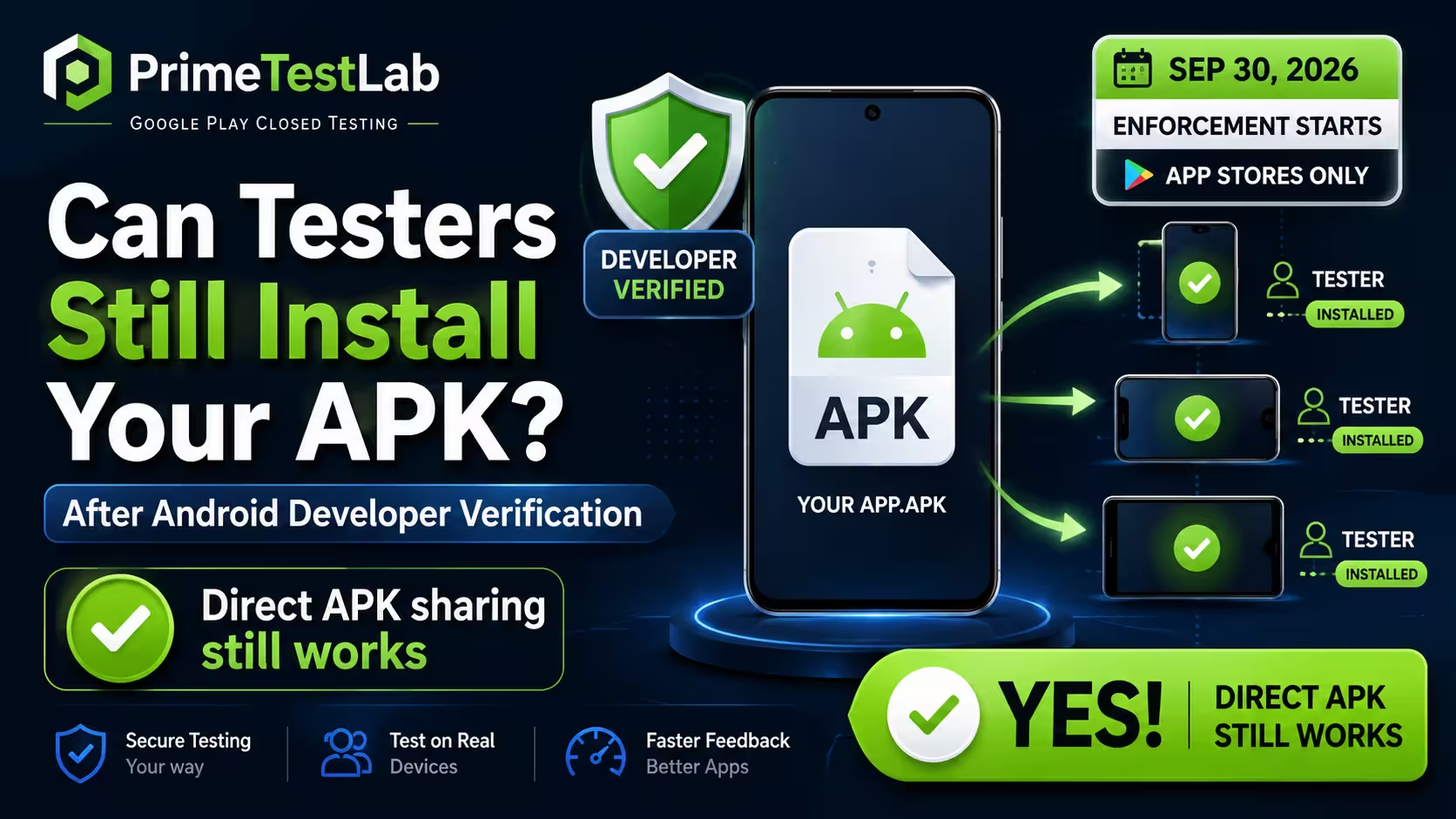
As of August 13, 2026, yes. Testers can still install an APK you send them directly. Google's September 30, 2026 first phase applies only to seven participating app stores in Brazil, Indonesia, Singapore and Thailand, so direct APK sideloading is not covered yet. Google plans broader enforcement on certified Android 7+ devices in 2027, with no exact worldwide date announced. Registered apps keep the normal install path; unregistered apps can still use ADB or Android's advanced flow. Firebase APK distribution likely falls in the direct-sideload lane, but Google has published no Firebase-specific ruling. None of these routes is the Google Play closed test, which needs 12 testers opted in for 14 continuous days.
How this post grades every claim
- Verified means the statement comes straight from a current Google, Android or Firebase page. Most of this post is verified. Verified
- Partial means the primary sources support the conclusion but it needs one inference step, or Google's own pages leave the edge case unaddressed. Partial
- Community reported means repeated developer accounts from Stack Overflow, Reddit or Google's own forums. Useful for troubleshooting, not policy. Community
- Not documented means Google has published nothing on that exact scenario, and we say so instead of guessing. Not documented
The story that spread in 2025 was simple: Android is ending sideloading. The position Google actually documents in August 2026 is narrower, more precise, and far less useful as a headline. Google clarified and refined the first-phase scope in its June 18, 2026 announcement and its July 15, 2026 FAQ update, and that second revision wrote the narrowing down in a single sentence: the September 30 deadline "only applies to the specific participating stores." Much of the 2025 and early-2026 coverage still in circulation was published before that sentence existed and describes a broader first rollout than the one Google is running.
So this post is organised around the decision you actually have to make rather than around the controversy. You have twelve friends, colleagues or testers and a build to get onto their phones. Can you still email the APK? Do you need ADB? Does Firebase App Distribution work? And the question that arrives in the PrimeTestLab inbox most weeks: does any of that count toward the 12-tester closed test Google demands before production access? Every date, figure and mechanism below was checked against Google's own pages on August 13, 2026, and where Google has published nothing, this post labels the gap instead of filling it.
Can testers still install your APK after September 30, 2026?
Yes. Under Google's current rules, a tester can still install an APK you send them directly after September 30, 2026. The date is real, the four countries are real, and the enforcement is real, but Google's current FAQ says the deadline "only applies to the specific participating stores." For a direct sideload, the same FAQ says it "won't apply to your app yet."
Google's exact wording, phrase by phrase
The deadline "only applies to the specific participating stores" · for a direct sideload it "won't apply to your app yet" · enforcement covers "certified Android devices running Android 7 or higher" · Google will "expand the Android verification requirement globally" in 2027
Fragments quoted individually from Google's Android developer verification FAQ (page updated August 10, 2026; the direct-sideload answer dated July 15, 2026) and the June 18, 2026 announcement, both accessed August 13, 2026. Verified
What September 30 touches, and what it does not
Three rows settle the question for almost every reader. The middle row is the one that differs from a lot of earlier coverage of this date.
Affected on September 30, 2026
Installing through one of seven participating stores in Brazil, Indonesia, Singapore or ThailandThe app has to be registered to a verified developer for the ordinary install to go through. Google states the non-Play part of this initial regional enforcement applies to mobile and tablet form factors.
Not covered yet by the first phase
A direct APK: emailed, downloaded from your site, shared on Drive, or installed over ADBGoogle's July 15 FAQ says the September 30 deadline does not yet apply to direct sideloading. App stores outside the participating list are also outside this first phase. The word doing the work in both sentences is yet. A Firebase App Distribution APK should inherit the same answer, because it is direct distribution of a signed APK, but Google has published no Firebase-specific ruling. Partial, inference
Unchanged either way
Google Play's own publishing rulesPlay separately requires every Play package to be registered, and the 12-tester closed test for qualifying new personal accounts is untouched by any of this. Verification does not shorten it, waive it, or replace it.
Scope from Google's Android developer verification FAQ (page updated August 10, 2026; direct-sideload answer dated July 15, 2026) and the June 18, 2026 announcement naming the date, the four countries and the seven stores. Play's closed testing requirement from Play Console Help answer 14151465. All accessed August 13, 2026.
Why this is not a loophole
"Not covered yet" is a description of a rollout phase, not a permanent exemption, and treating it as one is the mirror image of the mistake this post is correcting. Google has said the requirement expands globally in 2027. The right response to this section is relief about September and preparation for the year after it, which is exactly what the checklist near the end is for. Verified
What actually changes on September 30, 2026
Google set the date on June 18, 2026 and then narrowed it in writing on July 15. From September 30, an install through one of seven named stores in four named countries is checked: the app must be registered to a verified developer. Google's current FAQ says that first phase applies to the named participating stores, and that direct sideloading and non-participating stores are not covered yet.
If you publish on Google Play
Register every remaining package by September 30, 2026. Google's Play Console guide says to register any remaining apps you want to keep distributing "to avoid global removal from Google Play". This obligation is global. It has nothing to do with the four countries, and it applies even if not one of your users lives in them.
What users experience on September 30
Device-side enforcement starts in four countries only. The first installation check covers the seven participating stores in Brazil, Indonesia, Singapore and Thailand. It does not reach direct sideloading, and it does not reach stores outside that list.
These are two separate September 30 obligations and conflating them is the most common way to misread this date. Play package registration is global and is about your listing staying up; installation enforcement is regional and is about what happens on a user's phone. Verified
The seven participating stores
Name them exactly. Describing this as an all-app-store restriction is too broad under Google's current first-phase wording: under the list Google has published, a store that is not named here is outside the September 30 rollout.
| Company | Participating store | Checked from Sep 30 in the four countries? |
|---|---|---|
| Google Play | Yes | |
| HONOR | HONOR App Market | Yes |
| OPlus | OPPO App Market | Yes |
| Samsung | Galaxy Store | Yes |
| Transsion | Palm Store | Yes |
| vivo | V-Appstore | Yes |
| Xiaomi | GetApps | Yes |
| You, directly | Email, download link, your website, Drive, and by inference a Firebase App Distribution APK | No, not yet |
| Anyone else | Any app store not named above | No, not yet |
Store list and countries from Google's June 18, 2026 announcement; the exclusion of direct sideloading and non-participating stores from Google's verification FAQ (page updated August 10, 2026; this answer dated July 15, 2026). Accessed August 13, 2026. Verified
The four countries, and the form factors inside them
Two details narrow this further and are worth carrying with you. For distribution outside Google Play, Google's verification FAQ states that the selected-region enforcement applies initially to mobile and tablet form factors. The same FAQ says the protections are delivered through Google Play services on certified Android devices running Android 7 or higher, which is the eventual device scope rather than a September-only limit.
What does not change in September
The list below is short, but it covers how most small teams actually move a build. None of it is affected by the September 30 phase.
A direct sideload. Not covered by the first phase.
Also a direct sideload, with the same answer.
Direct distribution of a signed APK to invited testers, so it should sit outside the first phase. Google publishes no Firebase-specific ruling, so this is an inference from the direct-sideload rule rather than a stated exemption. See section 08 for the full picture. Partial, inference
Google says there are no changes to how ADB works. Section 05.
Outside the first phase, per the same FAQ answer.
That is a Play requirement in its own right, and it is global. Google said on June 18, 2026 that over 99% of Play developers' apps had already been registered. Its July 15, 2026 Play guide separately says 99% were registered automatically — two different statements from two different pages, so do not fuse them into “over 99% automatically registered.”
Two similar numbers that are not the same claim
Google's June 18, 2026 announcement says over 99% of Play developers' apps had been registered. Its July 15, 2026 Play guide separately says 99% of apps on Play were registered automatically. Those are two statements from two pages, so quote one and attach its date — never fuse them into “over 99% automatically registered.” Some material still repeats an older approximately 98% figure. Google's current developer-verification overview now rounds the same figure to 99%, so cite either number with its source and date attached rather than as an exact constant. Verified
What happens when verification expands globally in 2027
Google says the requirement expands globally in 2027 and beyond, to apps on certified Android devices running Android 7 or higher, delivered through Google Play services. It has not announced an exact worldwide date or a country-by-country schedule. Treat any specific 2027 date as unofficial unless Google publishes it.
The timeline, with what each date does to a shared APK
-
March 30, 2026
Verification starts rolling out to all developers
Google began rolling Android developer verification out to every developer in Play Console and the Android Developer Console.
Raw APK No user-facing install change from this date alone. Unverified app Still installable under existing Android behaviour. -
August 2026
Advanced flow and limited-distribution accounts go global
Google scheduled the global launch of the advanced installation flow and of limited-distribution accounts for August 2026. That month has now passed; confirm current availability on Google's verification pages rather than trusting the schedule. Partial
Raw APK Still available. Unverified app The advanced flow is the mechanism intended to preserve installing them. -
September 30, 2026
Registration enforcement begins in seven stores, four countries
Installations through Google Play, HONOR App Market, OPPO App Market, Samsung Galaxy Store, Transsion Palm Store, vivo V-Appstore and Xiaomi GetApps in Brazil, Indonesia, Singapore and Thailand require the app to be registered to a verified developer. Verified
Raw APK Not covered yet by this initial phase. Unverified app A participating-store install can be restricted; the direct route is untouched in this phase. -
2027 and beyond
Global expansion to certified Android devices
Verification expands worldwide for apps on certified Android devices running Android 7 or higher. This is the phase when normal direct installation of unregistered apps changes — not sideloading itself. Registered apps keep the ordinary install experience, and Google is explicit that the advanced flow and ADB remain available to users who choose them. Verified
Raw APK Registered app: the normal install route. Unregistered app: advanced flow or ADB under the announced model. Unverified app Advanced flow or ADB remains the announced route. -
Exact 2027 date
Not announced as of August 13, 2026
Google's published timeline says 2027 and beyond, and nothing more precise. No country sequence has been released either. Not documented
Raw APK Do not plan against a specific day. Unverified app Do not plan against a specific day.
Chronology from Google's March 30, 2026 rollout post, the June 18, 2026 announcement, and the Android developer verification FAQ (page updated August 10, 2026; the direct-sideload answer dated July 15, 2026). Accessed August 13, 2026.
The deadline that does not exist
"January 1, 2027" turns up in secondary coverage and in AI assistant answers. It is not in any Google source reviewed for this post. Google has committed to 2027 and beyond without naming a day. If a plan of yours depends on knowing that date, the honest status is that nobody outside Google knows it yet, and the practical hedge is to have your packages registered well before the year starts. Not documented
Verified APK versus unverified APK: what Android actually checks
"Am I verified?" is the wrong question by itself. Android developer verification creates what Google calls a formal, verifiable link between a developer identity, an app's package name, and the signing key or keys for that package. Identity verification is one link in that chain, not the whole chain.
The chain, link by link
Who you are, confirmed once through Play Console or the Android Developer Console.
Done once per accountThe app's identifier, for example com.example.app, registered to that verified identity.
Ownership is proven by supplying an APK signed with your private key. The Console supports adding and verifying multiple keys for one package.
Per key, not per buildWhere the chain is complete, Google says users' normal installation experience is preserved once broader enforcement applies.
The outcome you wantChain from Google's Android developer verification guides, including the ownership-proof description, and the multiple-signing-key support documented in the verification FAQ. Accessed August 13, 2026. Verified
Google is explicit that sideloading is fundamental to Android and that verified developers can continue distributing directly. The nuance the phrase hides is that a smooth install depends on the app being registered, not merely on you having passed an identity check. That is why this post says "registered to a verified developer" every time rather than the shorter, looser "verified app".
What if you use a debug key or a separate QA signing key?
This is where real QA teams get caught, because it is completely normal to ship a debug-signed build to internal testers and a release-signed build to the store. Those are different certificates over the same package name.
Signing-key audit, four questions
- Which certificate actually signs the APK your users install? That is the one to register. Under Play App Signing the app signing key signs the APK installed from Google Play, while the upload key only authenticates the artifact you upload to Play and is not automatically the certificate on the installed version. A debug, CI, QA or upload key matters to direct distribution only when that key actually signs the APK you hand to testers.
- Are the relevant ones registered against the package? Google supports adding and verifying multiple signing keys for a single package name, so you are not forced to collapse everything onto one key.
- Do not assume identity verification covers every key. Passing the identity step does not silently bless every certificate you have ever used.
- Two APKs sharing a package name but not a signature are not interchangeable. That is ordinary Android app-signing behaviour and it predates verification entirely, but it is easy to mistake for a developer-verification problem. See section 12.
Five edge cases Google has actually answered
These come up constantly and all five have published answers, so there is no need to guess at them.
Scope questions with documented answers
- Android 6 or older? Outside the stated scope. Google says enforcement applies to certified Android devices running Android 7 or higher, delivered through Google Play services. Verified
- Uncertified devices or custom ROMs without Google Play services? Google describes this enforcement as applying to certified Android devices through Play services. Do not generalise the rule to every custom ROM or uncertified device, because those sit outside the mechanism Google documents. Not documented for those devices
- Enterprise apps on managed devices? Apps distributed through your organisation store to managed devices do not need to complete verification, because your IT admin has vetted them. Google still recommends registering them in case the app is also installed from another source or onto an unmanaged device. Verified
- Where do I check whether a package is registered? Play developers: the Android developer verification page in Play Console, which shows status next to each app. Off-Play developers: the Package names tab in the Android Developer Console, showing Registered, Not registered or Draft. Android Studio Panda 4 and higher also shows registration status when you generate a signed APK or App Bundle. Verified
- Do off-Play developers pay $25? The full-distribution Android Developer Console account carries a $25 fee. The limited distribution account is free, needs no government ID, and is capped at 20 authorised devices. If you already publish on Google Play you manage verification in Play Console rather than opening a separate off-Play account. Confirm limited distribution's availability first: as of August 13, 2026 early access was still closed. Availability partial
Firebase requires signing too, for a different reason
Firebase App Distribution requires that an APK be signed with a debug key or an app signing key before it will distribute it. That is a Firebase requirement about build validity, not an Android developer verification step. The two systems both use the word "register", and keeping them apart is an important distinction in this whole topic. Section 08 separates them. Verified
The upload-key distinction also explains the most common Firebase support ticket. A Play-installed copy of your app may be signed by Google Play's app signing key, while the Firebase APK you hand the same tester is signed locally with an upload, release or debug key. Android cannot install one over the other unless the accepted signing identities match, so the tester sees a failure that looks like a verification problem and is not one. Verified
ADB is still allowed, but it is a developer workflow
Google's clearest commitment in this whole program, from its verification FAQ: there are no changes to how ADB works. Developers and power users can keep installing apps that way, and the advanced flow's 24-hour waiting period does not apply to ADB installs. It is the most durable technical route in this post, and also the least suitable for ordinary testers.
Good for
- You, on your own device, all day long
- A technical QA team that already has Android Studio installed
- CI pipelines and device farms
- Installing an unregistered build without waiting out the advanced flow's one-day delay
- A colleague sitting next to you with a USB cable
Bad for
- Twelve friends, family members or recruited testers
- Anyone you cannot walk through Developer options over the phone
- Remote testers in other countries with no cable and no laptop
- Rapid iteration: every new build needs access to the device and another install command, even though the tester does not redo the whole setup
- Anything you want Google Play to count. ADB installs are invisible to Play's testing requirements
What a tester has to do first
Google's own tooling documentation is blunt about the prerequisite: to use ADB over USB, you must enable USB debugging in the device's developer options. On a modern phone that means finding the build number, tapping it seven times to unlock Developer options, then enabling USB debugging inside a settings screen that carries a warning dialog. That workflow is practical for a technical tester and burdensome for a casual one who volunteered to try your app.
Setup is not repeated for every build, which is the detail most write-ups get wrong. Once the tester has authorised your workstation, that authorisation stays until they revoke it or forget the device, so a new build costs one more adb install -r and access to the phone, not another walk through Developer options. Android 11 and higher also support wireless debugging: the tester pairs the phone with the workstation once using a QR code or a pairing code, and after that you can install over the network while both devices are on it, with no cable at all. That removes the cable, not the technical prerequisite.
The three commands that cover almost every tester install. Nothing here is new in 2026; it is the workflow Google says is unchanged.
adb devicesadb install app-release.apkadb install -r app-release.apkThe one that surprises people: -r only works when the new APK is signed with the same certificate as the installed one. A build signed with a different key has to be uninstalled first, which takes the app's data with it. That is standard Android app-signing behaviour, not a verification rule.
Use ADB as the fallback, not the plan
Under Google's announced model, ADB is a documented fallback for installing unverified apps, including through the planned broader rollout. It is the route that keeps working when a build is unregistered and the tester will not sit through a one-day wait. It is still worth rechecking the policy before relying on that assumption in 2027. What it is not is a way to onboard twelve ordinary people, and it will never satisfy Google Play's production-access testing requirement. Verified
What is Android's advanced flow for unverified apps?
Google built a deliberate route for users who want to install an app from an unverified developer anyway. It is a one-time setup with a friction step in the middle: enable developer mode, confirm nobody is talking you through it, restart, wait one day, authenticate, and then allow unverified installs for 7 days or indefinitely. The 24-hour wait is part of that setup, not a delay before every APK.
-
01
Enable developer mode
The user turns on Developer mode or the equivalent setting on their device.
Google: this prevents accidental triggers and the one-tap bypasses used in high-pressure scams -
02
Confirm nobody is coaching them
The user confirms that no other person is walking them through this security change.
Google: a quick check that nobody is talking you into turning off your security -
03
Restart and reauthenticate
The device restarts and the user signs back in.
Google: this cuts off remote access or an active call a scammer is using to watch you -
04
Wait 24 hours — once
Google describes this as a one-time, one-day wait. It happens during setup, and it is the step everyone misreports.
Not 24 hours before every APK. Once, per account. -
05
Verify identity on the device
The user confirms the change with biometrics or the device PIN.
Google: biometric or PIN confirms the device owner is the one making the change -
06
Allow unverified installs for 7 days or indefinitely
Setup complete. The user chooses the duration, and can then work through the unverified-developer warning when installing.
Their choice, their risk, their device
Sequence, wording, duration options and the stated purpose of each step from Google's Android developer verification FAQ, accessed August 13, 2026. Google publishes a reason for every step in this flow, so the notes above report its rationale rather than inferring one. Verified
Three things people get wrong about it
"So every install needs a 24-hour wait?"
No. Google describes a one-time, one-day wait inside the setup. After that the user picks 7 days or indefinitely for how long unverified installs stay permitted.
"Do they redo this on every new phone?"
Google says no. The FAQ describes the setup as once per account, carrying over to a new device.
"Does ADB need the wait too?"
No. Google states explicitly that the 24-hour waiting period does not apply to ADB installs. Section 05.
Developer Options do not have to stay on
A tester can switch Developer Options back off once the advanced flow is enabled. Google's FAQ says so directly: you do not have to keep developer options enabled, because once you make the change on the device the setting is enabled. That matters for testers whose banking or enterprise apps complain when Developer Options is left on. Google also says the setup is completed once per account and carries to a new device, so it is not repeated for every app or every phone. Verified
Is it live right now?
Launch window has passed — verify before relying on it
Google scheduled the advanced flow to launch globally in August 2026 without publishing an exact day, and that month has now ended. This post was last checked against Google's pages on August 13, 2026, so confirm the flow's current availability on Google's Android developer verification pages before you build a tester support script around it. Partial
The practical read for a developer: the advanced flow is a real, documented answer to "can a user still install my unverified app?" and a poor answer to "how do I get a build to twelve testers this week." A one-day security delay in the middle of onboarding adds real friction for casual or remote testers. If your testers are ordinary users, the routes that respect their time are compared in section 09.
What happens to APKs that are already installed?
Google's documentation covers installing and updating. Once enforcement applies, an unregistered app cannot be installed or updated normally, and Google says an ordinary update "will fail" without the advanced flow or ADB. What the reviewed documentation does not say is that copies already on people's phones get removed or blocked from launching.
| Situation once broader enforcement applies | Documented result | Evidence |
|---|---|---|
| The app is already installed and the user just opens it | The Google documentation reviewed does not announce forced removal or runtime blocking. It discusses installation and updates. | Partial |
| A user tries to install an unregistered app the normal way | Normal installation is restricted. | Verified |
| The user has enabled the advanced flow | The unregistered app can be installed. | Verified |
| The install goes through ADB | The unregistered app can be installed. No advanced-flow wait applies. | Verified |
| An installed unregistered app receives an ordinary update, advanced flow off | Google says the update fails. | Verified |
| That same app is updated through ADB | Allowed, under Google's announced carve-out. | Verified |
Behaviour from Google's Android developer verification FAQ, accessed August 13, 2026. The first row states the absence of an announced mechanism, which is not the same as a promise that behaviour can never change.
Do not write "your app will be deleted"
It is the most viral claim in this topic and it is not supported. The accurate phrasing, and the one used throughout this post, is: Google documents restrictions on installation and updates; it has not announced that already-installed copies will be removed from devices or prevented from launching. Reporting the absence of a source is honest. Converting that absence into either a guarantee of safety or a prediction of mass deletion is not. Partial, absence of source
The distinction changes what you should actually do. A blocked update is a real, documented operational problem: an affected tester can stay on an older build because the update cannot install through the normal path, and they may never report it, because from their side nothing happened. A mass uninstall would be a completely different kind of emergency requiring completely different communication. Only one of the two is on the record.
Where Firebase App Distribution fits after verification
Firebase App Distribution is a way to get pre-release builds onto testers' devices. It is not a verification system, it is not a Google Play testing track, and it does not exempt anything from Android developer verification. What it does well is remove the manual work from handing a signed build to a list of people.
How the APK workflow actually runs
You upload a signed APK to the Firebase console. Firebase requires it to be signed with a debug key or an app signing key.
Select tester groups or individual testers for that release.
Testers receive an invite and install the distributed build.
Distributed builds stay available for 150 days. Tester invitations expire after 30 days, and Firebase warns 5 days before that happens.
Workflow, signing requirement, 150-day build retention and 30-day invitation expiry from Firebase App Distribution's Android documentation (last updated August 11, 2026), accessed August 13, 2026. Verified
Two expiry clocks, two different support tickets
The 30-day invitation expiry and the 150-day build retention are separate. A tester who ignores the email for five weeks has an expired invitation even though the build is still perfectly alive. That produces a confused "the link is broken" message that has nothing to do with verification, signing or Android at all. Verified
Does Firebase still work during the September phase?
Almost certainly yes, and it matters how you reach that conclusion. Firebase's APK workflow is direct distribution of a signed APK to invited testers. Google's FAQ says direct sideloading is not covered by the September 30 phase. Put those two facts together and Firebase APK distribution should remain usable through that first phase.
That conclusion is an inference, and it is labelled as one
No Google source names Firebase App Distribution and grants it an exemption. The conclusion above follows from two verified facts: direct sideloads are outside the initial September enforcement, and Firebase's APK workflow is direct distribution. It is a sound inference and it is still an inference, which is why this post grades it rather than asserting it flatly. Partial, inference
APK and AAB Firebase distribution are not the same thing
This is the nuance almost every article flattens. Firebase supports both, and they take different roads to the tester's phone.
| Firebase workflow | How the build reaches the tester | How to think about it for verification |
|---|---|---|
| APK | Firebase distributes the signed APK to invited testers directly. | Direct distribution. Behaves like the sideload lane, including in September. Partial |
| Android App Bundle (AAB) | Firebase's AAB workflow integrates with Google Play internal app sharing. | A Play-connected path, so do not reason about it as if it were the raw APK route. Google has not stated how it is treated under the September enforcement. Verified integration Enforcement not documented |
An AAB cannot be sideloaded at all
Before any of the verification questions matter, there is a plainer one people trip over: an Android App Bundle cannot be installed directly on a phone. A .aab is a publishing format, not a device-ready package. Google Play, Firebase's Play-connected AAB workflow, or bundletool has to turn it into APKs first. So if you need a file you can email, upload to Drive or hand to a tester directly, build an APK. Android's own build documentation says an app bundle cannot be deployed straight to a device. Verified
So "does Firebase still work?" has two answers depending on which artifact you upload. When you write about it, or when you ask a colleague about it, specify Firebase APK distribution or Firebase AAB distribution. The shorthand hides a detail that materially changes the analysis.
Does Firebase App Distribution count toward the 12-tester rule?
No. Google's production-access requirement for qualifying accounts asks for at least 12 testers opted into a Google Play closed test, continuously, for the previous 14 days. Firebase testers are not opted into a Play closed test, so testing through Firebase does not satisfy it no matter how many people take part or how thoroughly they test.
| Question | Firebase App Distribution | Google Play closed testing |
|---|---|---|
| What is it for? | Getting pre-release builds to testers fast | Satisfying Play's pre-production gate, and testing on the store |
| Where do testers opt in? | A Firebase invitation email | A Play opt-in link, on the closed track |
| Does it register your app for Android developer verification? | No Firebase's "register your app" is a different process entirely | No package registration is its own task |
| Does it satisfy the 12 testers / 14 continuous days requirement? | No | Yes for qualifying testers and accounts |
| Is it still worth using? | Yes as a QA channel, alongside the closed test | Yes it is the required path |
Play requirement from Play Console Help answer 14151465; Firebase behaviour from Firebase App Distribution documentation (last updated August 11, 2026). Both accessed August 13, 2026. The two products define different processes that share the word "register". Verified
The pattern this creates is worth naming, because it costs people two weeks. A developer runs a genuinely rigorous Firebase test with fifteen engaged testers, concludes the testing box is ticked, opens Play Console to apply for production access, and discovers the 14-day clock has not started. Section 10 puts the two requirements side by side so that cannot happen to you.
The best way to get a build to 12 testers in 2026
There is no single winner, because the routes solve different problems. A raw APK is the simplest thing that works today. ADB is the most durable and the least usable. Firebase is the best pure QA channel. And only one route on this page satisfies Google Play's production-access requirement, which is the thing that actually decides your launch date.
Distribution route checker
Nothing is sent anywhere. The logic runs in your browser using Google's published scope, Firebase's documentation and Play's production-access rule.
1 How are you getting the build to them?
2 Where are your testers?
3 Is the app registered to a verified developer?
Scope from Google's verification FAQ (page updated August 10, 2026), Firebase App Distribution docs and Play Console Help answer 14151465. Accessed August 13, 2026.
All seven routes, side by side
The tool answers one situation. This answers all of them, including the two columns people skip until it is too late: the announced 2027 behaviour, and whether the route does anything at all for your Play production-access application.
| Route | What the tester has to do | Sep 30, 2026 first phase | Announced 2027 model | Counts toward Play 12/14? | Practical verdict |
|---|---|---|---|---|---|
| Email, Drive or website raw APK | Download the APK and allow the install from that source | Still viable direct sideload is not covered yet | Registered app installs normally; unregistered app expected to need advanced flow or ADB | No | Fine for ad hoc QA today. Not the production-access test. |
| ADB | Enable Developer options and USB debugging, connect, install with developer tooling | Yes | Yes Google explicitly preserves ADB | No | Durable, but too technical for ordinary testers. |
| Firebase App Distribution, APK | Accept the invitation email and install the distributed build | Likely unaffected based on the direct-sideload rule. No Firebase-specific ruling. Partial | Registered package should stay smooth; an unregistered one follows the broader sideload model | No | Excellent QA workflow. Not a Play testing substitute. |
| Firebase App Distribution, AAB | Receives the build through a workflow integrated with Play internal app sharing | Not documented Play-connected through internal app sharing; Google has not stated how that path is treated Not documented | Depends on Play and package registration | No | Useful, and deserves its own explanation rather than being lumped in with Firebase APK. |
| Google Play internal testing | Join the internal test and install from Play | Viable for a properly registered Play app | Viable | No not a substitute for the required closed test | Good fast Play-based QA. Up to 100 testers. |
| Google Play closed testing | Opt in through the closed-test link and stay opted in | Viable | Viable | Yes for qualifying testers and accounts | The required path for affected new personal accounts seeking production access. |
| Android limited distribution | Their device has to be authorised under the limited-distribution system | Scheduled for August 2026, but early access was still closed as of August 13 Partial | Designed as a durable small-audience path | No | For hobbyists sharing with up to 20 devices. Free, no government ID, cannot publish to Play. |
Sources: Google's verification FAQ and guides, the ADB tooling documentation, Firebase App Distribution docs, limited distribution, Play Console Help on internal testing and on production-access testing requirements. All accessed August 13, 2026.
The honest recommendation
Run two tracks in parallel, because they answer different questions. Use whatever gets a build onto devices fastest for genuine QA: a raw APK for one colleague, Firebase for a group, ADB when you need to bypass everything. Then, separately and starting as early as possible, run the Play closed test if your account is subject to the production-access requirement, because that one is measured in wall-clock days and cannot be compressed by working harder.
The mistake worth avoiding is treating them as sequential. Finishing a thorough Firebase test does not advance the 14-day counter by a single day.
Developer verification does not replace Google Play closed testing
These are two unrelated requirements that people merge into one mental checkbox. Verification answers "who made and signed this package?" Closed testing answers "has this account completed Google's pre-production test?" Completing either one does nothing at all for the other.
Verification model from Google's Android developer verification guides; testing requirement from Play Console Help answer 14151465 and the internal-testing page (answer 9845334). Accessed August 13, 2026.
Why "internal testing counts, it is still a Play test" is wrong
Google permits up to 100 testers on an internal test, which makes it feel like the more serious option. But the production-access requirement is written around a specific track: the qualifying testers must have been opted into a closed test for the last 14 continuous days. Internal testing is a different track, so it does not satisfy that sentence.
A note on how this claim is sourced
Google does not publish a sentence reading "internal testing does not count." What it publishes is a requirement that specifies a closed test. The conclusion follows from the definition rather than from a quotation, and this post states it that way rather than putting words in Google's mouth. Verified by requirement definition
The numbers, and where they came from
Two pieces of history clear up questions that come up constantly. Google announced the requirement on November 9, 2023, and the current policy applies it to personal accounts created after November 13, 2023 — two different dates that mean two different things. And the minimum was originally 20 people for a minimum of two weeks. The reduction to 12 was announced on December 11, 2024 in a pinned Google Play Developer Community announcement posted by Google Play product support, and Google's current Help Center independently confirms 12 today. Verified
Organization accounts sit outside this particular gate: the requirement is scoped to qualifying personal accounts. And the fee is unchanged either way, a one-time US$25 Google Play registration. If you want the full account-type comparison rather than a paragraph, that is covered in personal versus organization accounts.
Ten claims about this that are out of date
Much of the coverage of Android developer verification was written before the June 18, 2026 announcement and the July FAQ made the first phase much narrower than early coverage suggested. The claims below are not lies; several were accurate when published. They are simply describing a version of the policy that no longer matches Google's current pages.
Claim All direct APK sideloads are blocked from September 30 in the four countries.
Current rule False under Google's July 15, 2026 FAQ. September 30 covers seven participating stores. Direct sideloads are not covered yet. Verified
Claim Developer verification means you cannot install an app from an unverified developer.
Current rule Too absolute. ADB remains available, and Google built the advanced flow specifically for unverified apps. Verified
Claim The global deadline is January 1, 2027.
Current rule Unsupported. Google has announced "2027 and beyond" and no exact global date. Not documented
Claim Once your identity is verified, any APK you sign is fine.
Current rule Incomplete. The package name and the relevant signing keys also have to be registered. Verified
Claim Firebase App Distribution verifies your Android app.
Current rule False conflation. Firebase's "register your app" and Android developer verification's registration are different systems. Verified
Claim Firebase testers count toward Google's 12 testers.
Current rule False. Google requires 12 testers opted into the Play closed test. Verified
Claim Play internal testing counts, because it is still a Play test.
Current rule Not for this gate. The production-access requirement specifically names a closed test. Verified by definition
Claim Unverified apps that are already installed will be deleted.
Current rule Unsupported. Google documents installation and update restrictions and announces no automatic removal of installed copies. Partial, absence of source
Claim The advanced flow is definitely live everywhere, because it is August.
Current rule Too strong. Google scheduled an August 2026 global launch without publishing an exact go-live day. Partial
Claim About 98% of Play apps were auto-registered.
Current rule Outdated. Google's June 18, 2026 update says over 99%. Verified
Where the two Google pages appear to disagree
This is worth naming because a careful reader will hit it. Google's general Help wording says that apps whose developers have not completed the requirement become unavailable for new installation in applicable countries, which sounds broader than the store-only carve-out. The more specific FAQ answer, dated July 15, 2026 on a page last updated August 10, 2026, says the September 30 deadline applies only to the participating stores and does not yet reach direct sideloading.
How this post resolves it, and why that is a judgement call
Editorial interpretation. For the September 30 first phase this post follows the newer, scenario-specific FAQ answer, because it addresses direct sideloading and non-participating stores by name rather than by implication, and its direct-sideload answer carries a July 15, 2026 stamp. The general Help wording describes the programme as a whole. Google has not published a formal rule saying one source overrides the other, so this is our editorial choice, stated openly rather than hidden. The two pages are better read as describing different layers of the same rollout than as a contradiction. Editorial interpretation
Symptom to fix: what is actually wrong
Find the sentence you or your tester actually said. A common cause of a failed tester install or update is a signing certificate mismatch, which is ordinary Android behaviour, has nothing to do with developer verification, and predates it by a decade.
"My friend can't install the APK after verification"
Likely explanation. Almost certainly not developer verification. Before the broader 2027 rollout, a failed direct APK install is not caused by the September 30 rule, because that rule does not reach the direct route yet. The most common real cause is a signing certificate mismatch: the phone already has a copy of the app signed with a different certificate.
Safest next check, in this order. Work through the ordinary Android install failures first: an installed copy signed with another certificate, a lower versionCode than the installed build, an unsupported Android version or CPU architecture, a truncated or corrupted download, not enough storage, the install-source permission not granted to the app delivering the file, or a Play Protect warning the tester dismissed. Then, and only if the install is going through a participating store or the broader enforcement has begun, check the package and signing-key registration.
Verified concept
"Firebase says installation failed over my Play version"
Likely explanation. A tester who already has a Play-signed build installed cannot update it in place with a Firebase APK signed by a different certificate. Developers have reported exactly this, and testers rarely understand the error message.
Safest next check. Compare the signing certificates on both artifacts. Either use a compatible signing path, or have the tester uninstall the old build first — which takes its data with it, so warn them.
Community-reported example
"Do I need to wait 24 hours to install with ADB?"
Answer. No. Google states that the advanced flow's 24-hour waiting period does not apply to ADB installs.
Next step. Use the normal ADB workflow. Section 05 has the commands.
Verified
"My unregistered app was already installed but won't update"
Likely explanation. Once enforcement applies to that install path, Google says updates to an unregistered app require the advanced flow or ADB, and an ordinary update fails.
Safest next check. Register the package properly. In the meantime, the tester can enable the advanced flow or you can push the update over ADB.
Verified
"I tested with 12 people in Firebase but Play still won't let me apply for production"
Likely explanation. Firebase testers are not opted into a Play closed-test track, so none of that testing registers against the production-access requirement.
Safest next check. Run the Play closed test: at least 12 qualifying testers, opted in and staying opted in, for 14 continuous days. The clock starts when they are actually enrolled, not when you started testing.
Verified
"I used 12 people in Play internal testing but production is still locked"
Likely explanation. Internal testing is not the track the production-access requirement names. The rule asks for a closed test.
Safest next check. Move the qualifying test to a Play closed track. Internal testing stays useful for fast QA alongside it.
Verified by policy definition
"My tester never got the Firebase invitation, or says the link is dead"
Likely explanation. Firebase tester invitations expire after 30 days, with a warning 5 days before. A tester who left the email for a month has an expired invitation even though the build itself is still available for 150 days.
Safest next check. Reissue the invitation before assuming anything about signing, verification or the device. Onboarding failures in App Distribution are often reported as account, invitation or install-source problems rather than problems with the build.
Verified Community-reported pattern
"An article says all sideloading stops on September 30"
Likely explanation. It relies on 2025 or early-2026 coverage written before Google narrowed the initial scope.
Safest next check. Read Google's verification FAQ directly. The current answer is that the September 30 deadline applies to the participating stores and does not yet cover direct sideloading.
Verified correction
The rule that saves the most support time
Two APKs with the same package name but unrelated signatures are not interchangeable, and never have been. Before you diagnose anything as a developer-verification problem, check whether you are simply asking Android to replace one app with a differently signed impostor of itself. Verification's architecture reinforces why signing identity matters, but this failure is easy to mistake for a developer-verification problem when it is neither new nor related.
What you should actually do before September 30
If you only distribute APKs directly, the September 30 first phase does not enforce developer verification on that path. That is temporary rather than permanent, and Google recommends completing verification before the global rollout begins in 2027. If you publish on Google Play, September 30 asks for one thing: every package registered. And separately from both, if your account faces the production-access gate, the 14-day clock is the item that decides your launch date, so it should already be running.
Pre-deadline tracker
Twelve items in the order they actually happen. Tick as you go; nothing is saved, so finish in one sitting or keep the tab open.
0 / 12 complete
Nothing ticked yet. Start by working out which lane you are in.
When this post goes out of date
This is an unusually perishable article and it would be dishonest to present it as evergreen. Below are the specific things most likely to change first, and what would make each one wrong.
The single most important refresh trigger on the page. If Google rewords the FAQ answer that currently says direct sideloading is not covered yet, the whole first half of this post changes.
Seven stores, four countries. Google may add stores or clarify behaviour on the day. Worth checking on September 29, on the day itself, and a week afterwards.
Both were scheduled for a global August 2026 launch with no published day. Their status can change without any policy change at all.
The moment Google names 2027 countries or dates, this post needs a country table it currently, correctly, does not have.
Firebase's APK and AAB docs move independently of each other, and Play's 12-tester, 14-day requirement lives on a Help page Google revises without announcement.
Refresh cadence used for this post: weekly through September 30, 2026, then on the enforcement date and roughly a week after it for implementation clarifications, then monthly until Google publishes a concrete 2027 schedule. That cadence is an editorial choice based on how often Google revised this program during 2026, not an official Google schedule.
Where PrimeTestLab fits, and where it does not
The boundary first, because it is the honest part. PrimeTestLab does not verify your identity, register your package names, or turn a Firebase test into a Play closed test. Those sit outside our closed-testing service, and this post is the whole of our contribution to them. Google does publish APIs and OAuth delegation through which an authorised platform can assist a developer with registration, but you would have to grant that access yourself and you remain responsible for the account and the app's identity. What we cover is the one requirement on this page that is made of calendar time rather than paperwork: 12 real testers, opted in for 14 consecutive days on a Play closed track.
That distinction is exactly the shape of the problem this article exists to fix. A developer distributes builds beautifully — Firebase groups, tidy release notes, engaged testers, real bug reports — then opens Play Console to apply for production access and finds that none of it counted. Distribution is a solved problem. The 14-day opt-in window is the part you cannot compress by being better organised.
Running the closed test yourself versus handing it over
Package registration, identity verification and production access are all decided by Google, and none of them is something we do for you. What a managed test removes is the tester recruitment and continuity risk, which is the step most first-time publishers actually stall on. Success rate across 9,800+ apps tested: 99.9%, in 120+ countries.
Three plans, one payment
Starter
12 testers $19.99Exactly the Google minimum, for a single app clearing the gate.
Professional
20 testers $29.99Headroom above the minimum, so one drop-out does not end the run.
Enterprise
25 testers $27.99For broader device and region coverage across the 14 days.
Every plan runs real testers on real devices for the full 14-day period, testing typically starts within 4-6 hours, and if a test does not deliver you get a free retest or a full refund. We do not promise Google's approval, because nobody can.
Frequently asked questions
Can my friends still install an APK I email them after September 30, 2026?
Yes, under Google's current initial-rollout rules. The September 30 deadline in Brazil, Indonesia, Singapore and Thailand applies to seven participating app stores, and Google's July 15, 2026 FAQ explicitly says direct sideloading is not covered yet. The broader requirement is still planned to expand globally in 2027, so treat this as a first-phase limitation rather than a permanent exemption.
Is Google blocking all sideloading in Brazil, Indonesia, Singapore and Thailand on September 30?
No, and this is the most important correction to older reporting. Initial enforcement is limited to Google Play, HONOR App Market, OPPO App Market, Samsung Galaxy Store, Transsion Palm Store, vivo V-Appstore and Xiaomi GetApps. Direct sideloading and app stores outside that list are explicitly outside the first phase. For non-Play distribution, Google states the selected-region enforcement applies initially to mobile and tablet form factors.
Will I still be able to sideload APKs after the global rollout?
For an app that is properly registered to a verified developer, Google says users' normal installation experience should remain unchanged. For an unverified or unregistered app, Google has preserved two routes: ADB, and an advanced flow through which a user can deliberately choose to install it. Google has not announced an exact global date for that broader phase, only 2027 and beyond.
Do I need Android developer verification to use ADB?
No. Google says developers and power users can continue using ADB to install unverified apps, and its 24-hour advanced-flow waiting period does not apply to ADB. ADB over USB does require Developer options and USB debugging to be enabled on the device, so it suits developers and technical testers far better than casual users.
Does the advanced flow make me wait 24 hours for every APK?
No. Google describes the 24-hour delay as part of the one-time setup for the advanced flow. Once that setup is complete, the user can allow installation of apps from unverified developers for seven days or indefinitely. Google also describes the setup as once per account, carrying over to a new device.
Will Android delete an unverified app that is already installed?
Google's reviewed documentation does not say existing copies will be automatically uninstalled or prevented from launching. It does say that once enforcement applies, an unregistered app cannot be installed or updated normally without the advanced flow or ADB, and that an ordinary update will fail. The accurate way to describe this is as install and update restrictions rather than deletion.
Does Firebase App Distribution bypass developer verification?
No. Firebase is a test-build distribution service, and registering an app with Firebase is not the same thing as Android developer verification, which links a verified developer to package names and signing keys. Firebase APK distribution should remain outside the initial September store enforcement because Google's FAQ says direct sideloading is not covered yet, but that is an inference from the sideload rule rather than a Firebase-specific exemption, and you should still prepare package registration for the 2027 rollout.
Do Firebase App Distribution testers count toward Google's 12-tester requirement?
No. Google requires affected accounts to have at least 12 testers opted into a Google Play closed test for the previous 14 continuous days before applying for production access. Firebase App Distribution is useful for finding bugs, but those testers are not opted into a Play closed track and do not satisfy that requirement.
Does Play internal testing count toward the 12 testers?
No, internal testing does not substitute for the required closed test. Google allows up to 100 testers on an internal test, but the production-access requirement specifically says the qualifying testers must have been opted into a closed test for 14 continuous days. Internal testing remains useful for fast quality assurance alongside the closed test.
I already verified my identity. Is any APK I build automatically okay?
Do not assume that. Android developer verification also involves registering the package name and its signing key or keys, and Google supports adding and verifying multiple signing keys for one package. This matters most when QA or debug builds and release builds use different signing certificates, which is a completely normal setup that identity verification alone does not cover.
Does verification mean my sideloaded APK now has to follow every Google Play policy?
Google's verification documentation describes identity confirmation and package registration, not an extension of every Play publication policy to all direct distribution. Google also distinguishes verifying who a developer is from the security screening applied to app content. Establishing identity is not the same as approving what you shipped, so do not treat off-Play distribution as equivalent to a Play Store review.
Bottom line
Summary
As of August 13, 2026, testers can still install a raw APK you share directly. Google's September 30, 2026 enforcement in Brazil, Indonesia, Singapore and Thailand initially applies only to seven participating app stores, and Google's July 15 FAQ says direct sideloads are not covered yet. Google plans broader enforcement on certified Android 7+ devices in 2027, with no exact worldwide date announced. Once that applies, apps registered to a verified developer keep the normal sideloading path, while unregistered apps can still be installed through ADB, which has no 24-hour wait, or through Google's advanced flow, whose 24-hour delay is a one-time setup step. Firebase App Distribution remains a strong QA channel, but it does not perform Android developer verification, its APK and AAB workflows behave differently, and it is not the Google Play closed test requiring 12 opted-in testers for 14 continuous days. If that testing step is the thing actually blocking your launch, PrimeTestLab supplies 12 real testers from $19.99. See pricing plans
Primary sources used for this post
Last policy check: August 13, 2026. Google's developer-verification FAQ page was last updated August 10, 2026, the direct-sideload answer on it is dated July 15, 2026, and Firebase's Android distribution documentation was last updated August 11, 2026. Android developer verification is actively rolling out, so the September 30 scope, the participating-store list, the advanced flow's availability and the 2027 schedule should all be rechecked against Google's own pages before you act on them. This post is scheduled for re-verification weekly through September 30, 2026, again on the enforcement date and roughly a week after it, and then monthly until Google publishes a concrete 2027 geography or date.