














Quick Answer
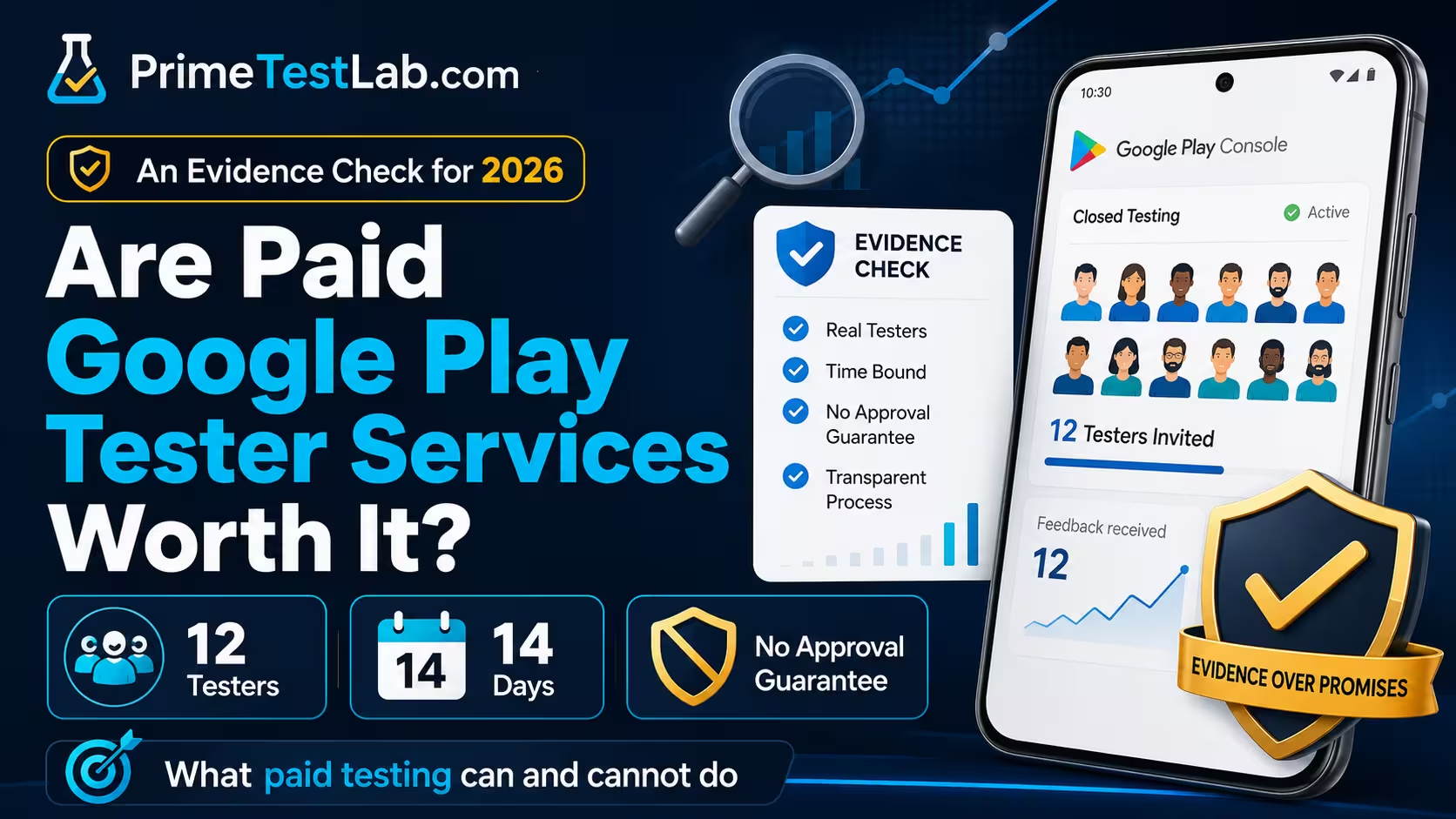
Paid Google Play tester services can be worth it when recruiting and coordinating 12 reliable Android testers for 14 continuous days is your bottleneck. Google's published rules do not expressly prohibit paying genuine QA testers, but Google does not endorse third-party services and no provider controls production access. Pay for real testing, private feedback and coordination, never for ratings, reviews or an approval promise.
The same answer, fully qualified As of August 12, 2026, no public Google Play policy located in this research explicitly prohibits paying people to perform genuine closed-test QA, and Google publishes no blanket endorsement or certification of third-party tester services either. For personal developer accounts created after November 13, 2023, the documented gate is a closed test with at least 12 testers opted in continuously for at least the last 14 days, after which the developer can apply for production access and Google can still require more testing if engagement or readiness is judged insufficient. A paid tester service can be worth it when recruiting, coordinating and retaining reliable Android testers is the bottleneck. It cannot shorten the 14 days and it cannot guarantee Google's decision. Choose a provider that supplies genuine testing and private feedback, does not offer public reviews, and says plainly what happens if Google asks for more testing.
From the people who publish this page
Need the recruitment and coordination side handled? See how PrimeTestLab manages the tester side of the process, including the answers we would give to this post's own vetting checklist.
The fear driving this question is rarely the money. Developers describe recruiting as a social effort they did not sign up for, then describe the worse part: waiting two weeks, applying, and being told to test again. That is why this post grades its own evidence out loud. Everything here is current as of August 12, 2026 and traces to Google's own Help Center pages, Google's developer blog, or clearly labelled community reports. Where a widely repeated claim has no located source, it is marked unverified rather than quietly rounded up into a rule. Google reduced this requirement from 20 testers to 12 on December 11, 2024, roughly 22 months ago, and pages still quoting 20 are the clearest proof that confident writing about this topic ages badly.
The Decision Bench
Three instruments built for this one purchase decision. Nothing here needs an account, an upload, or a network request. Everything runs in your browser on values you enter.
Are paid Google Play testers allowed?
No public Google Play policy located in this research prohibits paying people to perform genuine closed-test QA, and no Google source approves paid tester services either. Both halves of that sentence matter. The absence of a ban is not an endorsement, and anyone quoting one half without the other is selling you something.
Clearly acceptable
Recruitment routes Google itself recommends.
- Friends and family
- Coworkers and classmates
- Relevant online communities
- Groups of your target users
- Your own social followers
No public prohibition found
Not banned in the policies researched, and not endorsed either.
- Compensating a person to perform genuine QA
- Using a provider to recruit and coordinate testers
- Receiving private bug and usability feedback from a paid tester
This is a negative finding. Treat it as an absence of evidence, not as permission granted.
Explicitly against policy
Google's own words on this are not ambiguous.
- Paying for a positive Play Store rating
- Incentivized reviews or ratings of any kind
- Fraudulent reviews
- Automated services that inflate installs or ratings
Why "not prohibited" is the honest wording
Two searches produce two different silences. Search Google's published policies for a rule against compensating testers and you will not find one. Search the same policies for a statement that paid testing services are approved, certified or recommended, and you will not find that either. The second silence is the one competing pages skip, because "Google allows paid testers" makes for a much better sales page than "Google has not addressed this".
There is one widely repeated piece of evidence that seems to close the gap, and it deserves a careful label. Developers report that Google's own production-access questionnaire asks how testers were recruited and offers a paid testing provider as one of the example answers. If that wording is genuinely in the Console today, it is strong practical evidence that Google anticipates the practice. But it appears in a Console form rather than a published Help Center page, so the only public sources for it are developer accounts.
Community-reported, and worth saying so. The "paid testing provider" wording in the production questionnaire comes from developers reproducing what they saw in Play Console, not from a Google page anyone can open and check. Console forms change without a public changelog. Until Google publishes that wording, it belongs in the reported tier, not in the verified one. Reported
Paying for QA versus manipulating the store
The clearest way to think about the boundary is to stop asking whether money changed hands and start asking what the money bought. Paying someone to find bugs sits in one category. Paying someone to influence what the public sees on your store listing sits in a completely different one, and only the second is explicitly addressed by Google.
| Practice | Evidence-based status | What that means for you |
|---|---|---|
| Paying a person to perform genuine closed-test QA and report bugs | Partial No public prohibition found | Not expressly prohibited in the policies researched. No blanket Google endorsement exists either. |
| Recruiting friends, family, coworkers or classmates | Verified Google-recommended | A clearly acceptable recruitment channel, and the first one to exhaust. |
| Recruiting from relevant online communities or your target users | Verified Google-recommended | Clearly acceptable, and usually the best product feedback you will get. |
| Paying for a positive Play Store rating or a fake review | Prohibited Manipulation | Do not do it, and do not buy a testing package that includes it. |
| Offering incentives in exchange for ratings or reviews | Prohibited Manipulation | Do not do it. The incentive is the problem, not the wording around it. |
| Using automated services to inflate installs or ratings | Prohibited Manipulation | Do not do it. This is the clearest line Google draws in this whole area. |
| Using testers who only install and never meaningfully test | Verified Engagement is assessed | Not framed as a separate misconduct rule, but it is a live reason Google may ask you to keep testing. |
| A compensated tester sending you private bug and usability feedback | Partial No prohibition found | Keep QA feedback private and structured, and keep it entirely separate from public ratings. |
Statuses from this post's research dossier, built on Google Play Console Help answer 14151465 and the User Ratings, Reviews and Installs policy (answer 9898684). Accessed August 12, 2026.
What does Google actually require, and what did everyone else add?
Four things are documented: at least 12 testers, at least 14 continuous days of opt-in, a closed test, and a review of engagement and readiness after you apply. Almost everything else you have read about this requirement, including the daily-usage rule and the one-device-per-tester rule, is community guidance or folklore that has been repeated until it sounds official.
The whole gate at a glance
Every row here traces to a current Google page. If a service, a forum answer or an assistant tells you something that contradicts this table, the table is the thing to check first.
| Question | Documented answer | Grade |
|---|---|---|
| Who is subject to this gate? | Personal developer accounts created after November 13, 2023 | Verified |
| How many testers? | At least 12 | Verified |
| For how long? | Opted in for at least the last 14 days continuously | Verified |
| Which track counts? | Closed testing | Verified |
| Does internal testing replace it? | No. Internal testing is optional; the gate is written about closed testing | Verified |
| How many internal testers are allowed? | Up to 100, which is a different number for a different track | Verified |
| Was the minimum ever 20? | Yes. Reduced from 20 to 12 on December 11, 2024 | Verified |
| What happens after the 14 days? | You can apply for production access once the criteria are met | Verified |
| Is production access then automatic? | No. Google reviews engagement and readiness | Verified |
| How long does that review take? | Usually seven days or less, occasionally longer | Verified |
Every row from Google Play Console Help answers 14151465, 9859348 and 6112435, plus the Android Developers Blog post that announced the 20 to 12 reduction. Accessed August 12, 2026. Google changed this requirement once already, roughly 22 months ago, so pages still saying 20 testers are the fastest way to spot writing that has not been rechecked. We covered that change in detail in Google Play changed 20 testers to 12.
Three rules that are not rules
Each of these appears constantly in forum answers, in service marketing and in AI-generated summaries. None of them appears as a published threshold on Google's current requirements page, and the difference matters because two of them are used to sell you things.
Not published Unverified
“Every tester must open the app every day”
Google's current requirements page publishes no daily-open rule, no minimum number of sessions and no minutes-per-day figure. It asks instead whether testers used the app's features and whether their behaviour resembled real production usage. Product Experts in the Help Community sometimes recommend daily testing. That is not a published daily eligibility threshold, but weak or unrepresentative engagement can still contribute to Google requiring more testing, so "not a published rule" is not the same as "not examined".
Do this Prioritise meaningful use across the app's features and collect real feedback. Google publishes no daily-open threshold, but it does assess the quality of the testing and the engagement of the testers.
Not published Unverified
“One missed day resets your 14 days”
What Google actually documents is continuity of opt-in status, not continuity of activity. There is no located Google statement that a quiet day resets anything. The genuine risk is different and much simpler: if your count of opted-in testers falls below 12, you no longer have 12 testers with an unbroken qualifying run.
Do this Watch opt-in status, keep a buffer above 12, and read how the 14 consecutive days are counted.
Community guidance Reported
“Each tester needs their own physical device”
This one is different from the other two, because it is good advice with weak paperwork. The current requirements page does not state a unique-physical-device rule or an explicit emulator ban for this gate. Google Help Community Product Experts repeatedly say testers should be unique people on real devices and that emulator-only participation will not count, so real devices are the prudent standard.
Do this Use real people on real devices, and do not repeat it as a quoted policy line. More detail: emulators in Google Play closed testing.
Every one of these three claims can be used to sell you something. "Daily opens" justifies a premium engagement package, "the clock resets" manufactures urgency, and "unique physical devices" is the line providers use to explain why their offer is the only safe one. Two of them are unverified and the third is prudent advice rather than a published rule. A provider that presents any of them as a Google requirement is either repeating folklore or relying on you not checking.
What does paying for testers actually buy you?
Recruitment, coordination, device coverage and structured feedback. That is reach beyond your own contact list, a start you can schedule, someone watching the opt-in count, a spread of real devices, and findings you can actually use in the production application. What payment cannot buy is a shorter 14-day period or Google's production-access decision, because the continuous 14 days are a floor that applies to everyone equally and the decision belongs to Google.
What money can genuinely buy
- Reach past your own contact list. The single hardest part for a solo developer whose friends are on iPhone.
- A scheduled start. The clock cannot be shortened, but it can be started sooner, and that is a real saving.
- Someone watching the count. Dropouts are the failure mode that costs a whole cycle, and they are boring to monitor.
- Device and user coordination. Different phones, different Android versions, different people, without you managing a spreadsheet.
- Structured feedback. Findings you can summarise honestly when Google asks what you learned and what you changed.
What no payment changes
- The 14 continuous days. A documented minimum. No provider, price or plan compresses it.
- Google's production-access decision. Reviewed by Google after you apply, on evidence you supply.
- The engagement judgement. Google can still conclude that testing was too thin and ask for more.
- Whether your app is ready. Twelve testers on a build that crashes at launch produces twelve reports of the same crash.
- Audience fit. Generic testers can satisfy a head count without ever being your actual users.
The real DIY cost is coordination, not a Google fee
Google charges a one-time US$25 fee to register a Play Console developer account. It does not charge a separate fee each time you create a closed-testing track, add testers or apply for production access. If the decision were only about Google's charges, nobody would ever pay for testers.
There is one exception worth planning around, and it is the exception every page on this topic seems to miss. If the app itself is paid, testers in an open or closed test still have to purchase it. Only internal testers can install a paid app for free, and internal testing is the track that does not satisfy this requirement. So a paid app running its qualifying closed test asks twelve people to buy it, which is a real cost to them, a real ask on top of installing an unfinished build, and something to settle before you recruit rather than after. If your app is free, none of this applies.
Three different amounts of money, and they get conflated constantly. Google's $25 is a one-time developer registration fee. The price of a paid app is what open and closed testers pay to install it, and internal testers do not. Anything you pay a testing provider is a third, private transaction that Google is not party to. A provider quoting "no Google fees" is telling you something true and irrelevant. Verified
The cost that actually varies is the unpaid one. For a developer with a dozen Android-using colleagues, recruitment is an afternoon of messages. For a developer whose network is on iOS, who is building in a country where their contacts are not the target audience, or who is simply not comfortable asking people for their Gmail addresses, it becomes an open-ended project with no guaranteed end date.
“I just realized after 10 days of recruiting and now I have to wait for another 14 days.”
Reported One developer, on a public forum thread. A single account, not an average.
“It was a massive, uncomfortable social effort just to find the testers.”
Reported A developer describing friends and family who were mostly on iPhone, and strangers unwilling to install an unfamiliar app.
About three weeks to reach the threshold.
Reported, historical From Google's Help Community in 2023, when the requirement was still 20 testers rather than 12. It cannot be read as a current figure.
You will not find an average here, because there is not one. Plenty of pages quote a tidy figure for how many hours DIY recruitment takes. No representative dataset supports any of them. The honest range runs from negligible, if you already have the people, to weeks if you do not, and which end you land on is exactly what the meter further down this post is designed to help you work out.
What the market actually charges, and what the price does not tell you
A "worth it" question needs a number to weigh, and no page on this topic seems willing to print one. Here is the range of publicly advertised entry prices, checked on August 14, 2026. No seller is named, in keeping with the rest of this post: naming one dates the page and turns a cost comparison into a comparison ad, and the pattern outlives any particular listing.
| How you get the testers | Advertised entry price | What you are actually trading |
|---|---|---|
| Your own network Friends, coworkers, classmates, existing users |
$0 | Your time and your social capital. Retention over 14 days is yours to manage, and it is the part people underestimate. |
| Reciprocal tester communities You test theirs, they test yours |
$0 in cash | Your own testing time, paid back in kind. Genuinely free only if your hours are worth less than the fee. |
| Freelance marketplace gigs Individual sellers on general marketplaces |
From about $5 | The widest quality spread on this list. Several listings at this price advertise guaranteed approval or "100% approval", which is the first entry in the red-flag list below and not a thing any seller can deliver. |
| Specialist managed services Companies that only do this |
Roughly $15 to $40 for entry plans | Coordination, monitoring and a buffer above the minimum. What varies inside this band is not the head count but whether real testing happens, which is what the checklist further down is for. |
| Full QA engagement An agency or contract QA team |
Higher, and highly variable | A different purchase entirely: real product feedback and formal reporting, of which satisfying this requirement is a side effect. |
Read that table as a snapshot, not a benchmark. These are advertised entry prices seen on one day, not a survey, not an average and not what every buyer pays. This niche re-prices constantly. More importantly, price is close to the least informative thing about any of these routes: a $5 listing and a $40 plan can promise the identical head count and deliver completely different testing, and the gap only becomes visible when Google asks what your testers actually did. The eight-times price difference is not the risk. Buying a number instead of a test is the risk.
Registration fee from Google Play Console Help answer 6112435. The paid-app rule, that open and closed testers purchase a paid app while internal testers install it free, is from Google's Play Console closed testing page. Anecdotes are reproduced from public developer forums and Google's Help Community as labelled single reports, listed with their venues in the community sources block at the end of this post. What the $25 does and does not cover is broken down in you paid Google $25, now what.
When is paying for Google Play testers worth it, and when should you not pay?
When acquiring and holding suitable testers is the part you cannot reliably solve, and not simply because the rule applies to you. The rule applying to you is not the deciding factor, because Google's own recommended recruitment routes are free. The deciding factor is whether you can put 12 real Android users in a closed test and keep them there, engaged, for 14 continuous days.
Paying is most defensible when all five of these are true at once. If several are false, the money buys you very little that you could not arrange yourself.
- The app is genuinely ready to be tested. Testers cannot rescue a build that crashes on launch, and a bad first impression wastes the window you are paying for.
- You are actually subject to the gate. It applies to personal developer accounts created after November 13, 2023.
- Finding and retaining suitable Android testers is the bottleneck. Not the money, not the paperwork, not the build.
- Your launch has real opportunity cost. A slipped date costs you something concrete, so weeks of recruiting are not free time.
- The provider supplies engagement and feedback, not email addresses. Google asks what testers did and what you changed because of it.
Coordination risk meter
Five questions about your situation, not your budget. The meter scores how hard it will be to acquire and hold 12 qualifying testers, which is the only part of this decision a service can genuinely change.
Scope Is this a personal developer account created after November 13, 2023?
01 How many reliable Android users could you name today?
02 What does the rest of your network carry?
03 Could you keep those people opted in and actually using the app for 14 continuous days?
04 How specialised are the people your app is built for?
05 Which is tighter for you right now?
Factors and weights are this post's editorial model of the coordination problem described in Google's recruitment guidance and in developer community reports. They are not a Google scoring system, and no Google source ranks these factors. The meter holds its recommendation until every factor is answered, because a partly filled scorecard produces a confident-looking number out of answers you never gave.
Eight situations, and what each one actually calls for
The meter compresses your situation into one number. This table does the opposite: it names the situation and gives the honest recommendation for it, including the four rows where the answer is that you should not be buying testers at all.
| Your situation | Doing it yourself | A managed service | Recommendation |
|---|---|---|---|
| You already know 12 or more reliable Android users | Strong option | Usually unnecessary for the gate | Do it yourself. Google itself recommends personal and professional networks first. |
| You have a class, team, client base, club or active community that matches your audience | Strong, and usually better product feedback | Adds head count, adds little product insight | Do it yourself or mix. Representative users are worth more than generic ones. |
| You have a handful of Android contacts and most people you know use iOS | Recruiting gets slow and socially awkward | Solves the recruitment and coordination bottleneck | Paying can be rational. Community reports document this exact pain repeatedly. |
| You can find 12 names but cannot keep anyone engaged | High ongoing coordination burden | Useful only if the provider manages real activity and feedback | Vet the process. Buy the engagement, not the tester count. |
| Your app serves a specialised professional, medical or enterprise niche | Friends may give poor product feedback | Generic testers may also be poor product testers | Recruit real target users wherever you can. Google's guidance favours testers who resemble your future users. |
| You are not subject to the new-personal-account gate | No need to recruit 12 for this rule | Paying purely for gate compliance is unnecessary | Do not buy a requirement you do not have. Test for quality as appropriate. |
| Budget is tighter than your schedule | Free recruiting and community routes make sense | An added cash cost you can avoid | Do it yourself if you can carry the coordination time. |
| Time and coordination are tighter than a small service fee | Opportunity cost can dominate the decision | Outsourcing can make economic sense | Paying is most defensible here, assuming the provider passes the vetting checklist. |
Four situations where the money buys you nothing
Four of those rows deserve saying flatly rather than in a table cell, because a post that sells testing and never tells anyone not to buy is a landing page wearing an article's clothes. In all four, you would be paying for something you already have.
- You already have 12 or more reliable Android users. If you can name twelve people who will opt in, stay opted in and tell you what broke, the hard part is done. No service will care about your app more than someone who knows you. Spend the effort on the test scenarios you send them instead.
- A class, team, client base or community already fits your audience. A group that matches your target users is worth more than a group that matches your head count, and Google's guidance explicitly favours testers who resemble your future users. Recruiting from them is worth an extra week.
- You are outside the documented scope. The gate is written for personal developer accounts created after November 13, 2023. If yours is an organization account or predates that cutoff, do not buy testers for a requirement you were never given. Check your account type first.
- The build is not ready to be tested. Twelve testers on a build that crashes on launch produce twelve reports of the same crash, and the two weeks are gone either way. Testing capacity is the last thing to buy, not the first.
The specialised-app trap
There is a fifth case that is less clear cut. If your app serves a narrow professional, medical, industrial or enterprise audience, generic testers will solve your head-count problem and may still be poor testers of your product. They can confirm that the app installs, launches and does not crash. They cannot tell you that the workflow makes no sense to a radiographer, a warehouse supervisor or a tax preparer.
That does not mean skipping paid testing. It means the head count and the product feedback are two separate jobs, and buying one does not deliver the other. The strongest arrangement here is usually a mix: recruit as many real target users as you can reach, and treat any purchased capacity as the floor underneath them rather than a replacement for them. Nothing in Google's published requirement asks all 12 testers to come from the same place.
Situations and recommendations from this post's research dossier, built on Google's published recruitment guidance and labelled community reports. Free recruitment routes are ranked and compared separately in seven legitimate ways to get 12 testers for Google Play; this post does not repeat them.
What are the red flags that a testing service is selling the wrong thing?
The strongest signal is a promise that is structurally stronger than anything Google itself promises. Google says meeting the criteria makes you eligible to apply, and that review usually takes seven days or less. A seller offering guaranteed approval, a compressed 14-day requirement or a bundle of five-star reviews is not offering a better service. It is describing something that either is not theirs to give or is against policy.
Everything in this list is worth weighing. Three of them are not a matter of degree, because each asks you to accept something the provider cannot deliver or should not be selling: a guaranteed approval, public reviews, and your account credentials. Those three are marked Deal breaker below, and they are the three rows in the scorecard further down that override the score entirely.
-
Critical “100% Google approval guaranteed” Deal breaker
Why it matters Google, not the provider, decides production access after reviewing your testing and your app's readiness.
Not the same thing A promise to retest free, to keep testing, or to refund is a different kind of promise. Those cover the provider's own service, which is theirs to control, and they are worth having in writing. The red flag is a promise about Google's decision, or wording that quietly presents a service remedy as though it were an approval.
Your move Treat an approval promise as a credibility problem, not a benefit. Ask what remedy covers their own service instead, and read it in their actual terms.
-
Critical “We complete the 14-day requirement in 24 to 48 hours”
Why it matters The documented minimum is 14 continuous days of opt-in. Nobody can shorten it, including Google's own customers.
Your move Ask whether they mean recruitment starts that fast, which is plausible, or that the requirement completes that fast, which is not.
-
Critical “We will leave you five-star reviews too” Deal breaker
Why it matters Incentivized and fraudulent ratings and reviews are explicitly prohibited. This is the one boundary in this topic that is not ambiguous. A seller who bundles public ratings into a testing package has moved out of QA entirely.
Your move Decline that part of the offer, and treat it as a separate product you are refusing rather than a discount you are receiving. Testing feedback belongs in Play Console, privately, not on your public listing.
-
Critical “Just give us your Play Console or Google account login” Deal breaker
Why it matters It widens your security exposure without explaining why. Closed testing runs on tester email addresses on your list, not on control of your developer account. A provider that cannot explain the minimum access it needs, and why, is asking you to carry a risk for its own convenience.
Your move Require the minimum necessary access and a clear reason for it. Never share account credentials.
-
High “Install only, no need to actually test”
Why it matters Google asks about engagement, feature usage, feedback and production-like behaviour. Installs alone give you nothing to answer with.
Your move Ask for the engagement plan in writing, or look elsewhere.
-
High They will not say whether testers are people, or what devices they use
Why it matters It makes inauthentic testing impossible to rule out, and you are the one carrying the outcome.
Your move Ask for the process and the device mix before paying, not after.
-
High Heavy emulator language, no mention of physical devices
Why it matters Google's Help Community consistently cautions that qualifying testers should be real people on real devices, even though the requirements page is less explicit.
Your move Treat it as elevated risk. Describe the evidence accurately rather than claiming Google bans emulators outright.
-
High They offer to write your production-access answers in advance
Why it matters Google's questions ask what actually happened during your test. Answers written before the test describe a test that did not occur.
Your move Accept help drafting from real testing evidence. Refuse a pre-written script.
-
Medium No feedback deliverable of any kind
Why it matters It leaves you with nothing for the questions about feedback received and changes made.
Your move Ask exactly what artifacts you receive and what a sample looks like.
-
Medium The guarantee describes Google's decision instead of their service
Why it matters A remedy is only meaningful if it covers something the provider controls.
Your move Read the actual terms. A clear service remedy beats a bold outcome promise every time.
The one red flag that is pure arithmetic
Most of the list above is a judgement call. The 24-hour promise is not. The requirement is 12 testers opted in continuously for at least the last 14 days, so the earliest any developer on earth can satisfy it is 14 days after the twelfth tester opts in. A service can start recruiting within hours, and that is a genuine advantage worth paying for. A service cannot complete the requirement in less time than the requirement takes, and any wording that blurs those two things is worth reading very slowly.
Ask yourself who controls the thing being promised. Recruitment speed, device mix, tester communication and feedback quality are all controlled by the provider, so promises about them are meaningful. Approval, review time and what Google concludes about your engagement are controlled by Google, so promises about them are not the provider's to make.
What should I ask before paying a Google Play tester provider?
Ask twelve questions, and treat three of the answers as conversation enders. Most vetting advice tells you to look for a professional website, which tells you nothing. The questions below separate a service that coordinates real testing from one that sells a head count, and they work the same way whether the seller is a freelancer on a marketplace, an agency, a tester exchange or a specialist service.
Provider vetting scorecard
Score the answers you actually got. Three of these rows end the conversation on their own, whatever the other nine say. Your answers stay in this browser and are saved as you go.
-
01 Are the testers individual human users, and how do you manage them?
Exposes Automated or throwaway activity
-
02 Are they testing on physical Android devices, and what device and version mix do you have?
Exposes Emulator concentration and poor device coverage
-
03 How do you keep at least 12 testers opted in for the full continuous 14 days?
Exposes Dropout during the qualifying window
-
04 What do testers actually do besides install the app?
Exposes Installation-only box ticking
-
05 What feedback will I actually receive?
Exposes Nothing to answer Google's questions with
-
06 Do you ever ask testers to leave a public star rating or Play Store review?
Exposes Direct store-manipulation risk Deal breaker
-
07 Do you promise that Google will approve production access?
Exposes Provider misrepresentation Deal breaker
-
08 What happens if Google asks me to test more?
Exposes Hidden retest and refund terms
-
09 Will you write my production-access answers for me, and based on what evidence?
Exposes Fabricated questionnaire answers
-
10 What Play Console access do you need, and why?
Exposes Account and credential security Deal breaker
-
11 How do you handle apps with logins, personal data, payments or sensitive workflows?
Exposes Privacy and security exposure
-
12 Can you show the testing evidence I would need to describe this test honestly to Google?
Exposes An empty head-count service
Questions and risks from the vetting checklist in this post's research dossier. Weighting and the deal-breaker rule are this post's editorial judgement, not a Google standard. Unanswered rows are left out of the score rather than counted as zero, so a partial score reflects only what you have actually asked.
Everything on this scorecard is a matter of degree except three rows: questions 06, 07 and 10. A bad answer to any of those overrides the total, because each asks you to accept an outcome the provider does not control, a practice Google prohibits, or access it should not need. They are set out in full as the marked deal breakers in the red flags section above rather than repeated here.
Questions and risks from this post's research dossier. Related reading on the same lane: seven legitimate ways to find 12 testers covers the recruitment routes themselves, and emulators in closed testing covers the device question in depth.
Is paying testers the same as paying for reviews?
No, and this is the one boundary in this topic that Google states plainly. Closed-test feedback is private and goes to you. Public ratings and reviews are the store's signal to other users, and manipulating them is explicitly prohibited. Keep the two completely separate and most of the risk in this area disappears.
“We prohibit any manipulation of ratings, reviews or install counts.”
Google Play, User Ratings, Reviews and Installs policy, answer 9898684 Verified
That policy covers fraudulent and incentivized reviews and ratings, and automated services used to inflate installs or ratings. Notice what it does not mention: bug reports, usability findings, crash logs, or anyone being compensated for finding them. The policy is about what appears on your store listing and what other users rely on when deciding to install. QA feedback never touches any of that.
Closed-test feedback
- Private. Testers can submit feedback that goes to you rather than to the public listing.
- For you. It exists so you can fix things before real users arrive.
- Where it lives. Current Help guidance points to Ratings and reviews, then Testing feedback in Play Console.
- Useful later. It is the raw material for the questions Google asks about feedback and changes.
Public ratings and reviews
- Public. They shape what every future visitor to your listing sees.
- Explicitly protected. Manipulation is prohibited, including when it is incentivized.
- Not a testing deliverable. No Google closed-testing instruction asks your testers to rate you.
- Not something to buy. If a testing package includes them, that is the part to refuse.
If a provider offers ratings or reviews as part of a testing package, whether it is described as a bonus, a favour or "helping the launch", treat that as a separate product you are declining rather than a discount you are receiving. Everything else about the arrangement may be perfectly reasonable, and this one part is not.
There is a quieter version of the same mistake worth naming. Asking your paid testers to "leave a nice review to help the app" feels informal rather than transactional, but the testers are compensated, so the rating is incentivized regardless of how casually it was requested. Ask for bug reports instead. They are worth more to you anyway.
What happens after the 14 days are over?
You become eligible to apply, and then Google reviews you. Twelve testers opted in continuously for the last 14 days is the gate that lets an affected developer request production access. It is not an approval, and Google explicitly names insufficient tester engagement as a reason an app may be told to keep testing.
The five steps between your last test day and production
The criteria are met
At least 12 testers, opted in continuously for at least the last 14 days, on a closed test. Internal testing does not stand in for this.
You apply from the Dashboard
In current Play Console wording, the app Dashboard carries Apply for production. After approval, Production lives under Test and release.
You answer three areas of questions
The closed test, the app or game itself, and production readiness. Google asks how you recruited testers, how engaged they were, what feedback you received, what you changed because of it, and why the app is ready.
Google reviews it
Google says this usually takes seven days or less, but it can take longer. That is review time on top of the 14 days, not part of them.
Or you are asked to keep testing
Insufficient tester engagement is an example Google gives for why an app may need continued testing. This is the outcome the whole post is really about, and it is the one a paid service cannot buy you out of.
“If you have a newly created personal developer account, you must run a closed test for your app with a minimum of 12 testers who have been opted-in for at least the last 14 days continuously.”
Google Play Console Help, answer 14151465 Verified
Read that sentence twice, because two words in it decide most of the confusion in this topic. Minimum means 12 is a floor, not a target. Continuously means the qualifying period is measured as an unbroken run of opt-in status, so a tester who opts in, drops out and rejoins does not reach 14 qualifying days by adding the pieces together. What Google does not say anywhere on that page is how often a tester must open the app.
Earliest apply date planner
Calendar arithmetic on the dates you enter, worked from today. It shows when your 14 continuous days can close and where Google's own review estimate would land. It does not predict Google's decision, because nothing can.
Leave this empty if you are not at 12 yet.
03 Since that date, has the count ever dropped below 12?
Needed before the planner will project a date for a group already at 12, because a dip restarts the continuous run.
04 If you still need testers, how long will finding them take?
Needed before the planner can project a date, because the answer moves every date below.
The 14-day period and the seven-day review estimate are Google's published figures. Everything else here is arithmetic on your own inputs, and the planner will not project a date from an input you have not given. Meeting these dates makes an affected developer eligible to apply; it is not an approval, and Google can still ask for more testing.
Eight things that go wrong, and what each one usually means
These are the symptoms developers describe most often after a test that felt complete. The middle column is the thing to investigate, not a diagnosis, because Google does not publish the signals behind its review.
| What you are seeing | Likely issue to investigate | Safest action |
|---|---|---|
| I have 12 emails on my list but Console shows fewer testers | Being on an email list is not the same as having joined and stayed opted in | Check that each tester completed the opt-in flow, and watch the status in Console. The rule counts opted-in testers. |
| I ran internal testing with 12 people | Wrong track for this gate | Run the closed test the requirement is written about. Internal testing is optional and does not substitute. |
| We hit 12, then one person opted out | That tester's run is no longer 14 continuous days | Keep at least 12 qualifying testers and monitor continuity. A buffer above 12 is operational advice, not a Google rule. |
| All 12 stayed enrolled, but Google asked for more testing | Engagement or readiness may have been judged insufficient | Give testers real scenarios, collect feedback, fix what it surfaces, and answer the next application factually. |
| My testers installed the app once and never came back | Weak evidence of meaningful engagement | Send feature-level tasks rather than a link, and gather what they found before you apply. |
| A service says it can guarantee approval | The seller is promising an outcome Google controls | Judge it on tester quality and its own written remedy instead. Approval language is not a feature. |
| The provider wants testers to post ratings | QA is being mixed with store manipulation | Do not incentivize public ratings or reviews. Google prohibits manipulating them. |
| Someone told me they have to open it every day | Community lore is being treated as a formal threshold | Aim for meaningful use and real feedback. Google assesses engagement but publishes no daily-open or minimum-minutes rule. |
Symptoms and actions from this post's research dossier. Deeper on two of these rows: added 12 testers but Console shows 0 opted in, and how to answer the production access questionnaire.
How does PrimeTestLab handle the tester side?
We solve the coordination problem, and we say plainly that we do not solve the decision problem. 12 or more real testers on real devices, opted in for the full 14 days, with feedback you can actually cite in the production application. What happens after you apply is between you and Google, and any provider telling you otherwise is describing something they do not control.
Our answers to the twelve questions above
This post published a vetting checklist, so it would be a poor look to skip it. These are the answers we would give if you scored us with the tool in that section.
What we do
- Real people, real devices. Testers on physical Android devices spanning Android 7 to 17, with a deliberate spread of models and versions.
- Developers in 120+ countries. That is where our customers are, which is a different claim from where the testers are, and worth keeping separate.
- We hold the count. The group is monitored for the whole window, because a dip below the minimum is the failure that costs a cycle.
- Buffers, not exactly 12. Larger plans exist specifically so a dropout is an inconvenience rather than a restart.
- Feedback you can cite. Written findings, so you have something real to say when Google asks what you learned and what changed.
- A start you can plan around. Testing begins in 4-6 hours, which is the part of the calendar that genuinely can be compressed.
What we will not claim
- No approval promise. Google reviews production access. Nobody sells that, and we do not pretend to.
- No compressed 14 days. The continuous period is a documented minimum and applies to every customer we have.
- No ratings or reviews. Not offered, not as a bonus, not on request. It is prohibited and it is not testing.
- No invented questionnaire answers. Help drafting from what actually happened, never a script written before the test.
- No account credentials. Tester emails go on your list. Your Console stays yours.
| What has to happen | Doing it yourself | With PrimeTestLab |
|---|---|---|
| Find at least 12 real Android testers | Your own network first, then communities. Free, and the duration depends entirely on who you know. | Supplied from an existing tester pool, so your contact list is not the constraint. |
| Keep them opted in for 14 continuous days | You chase people, and one quiet dropout can cost the window. | Monitored for the full period, with larger plans carrying a deliberate buffer. |
| Cover a spread of devices and Android versions | Whatever phones your friends happen to own. | Real devices spanning Android 7 to 17, chosen for model and version spread rather than whatever is nearest. Ten reports from ten near-identical phones is not device coverage. |
| Get testers to actually use the app | Depends on goodwill, and goodwill fades in week two. | Testers work through the app rather than installing and disappearing. |
| Have feedback to cite in the application | Whatever people remember to send you. | Written findings you can summarise honestly. |
| Know what happens if Google asks for more testing | You start another cycle at your own cost in time. | Free retest or a full refund, your choice. That covers our service, not Google's decision. |
| Cost | No cash cost beyond Google's one-time $25 registration fee. | From $19.99 per app, one payment, no subscription. Checkout adds a 5% service fee with a $1.50 minimum, so the 12-tester plan comes to $21.49. |
Starter
12 Testers
$19.99
Enterprise
25 Testers
$27.99
Free retest or a full refund · Testing starts in 4-6 hours · No subscription · +5% service fee at checkout, $1.50 minimum
Two things about those prices, before you notice them yourself. The 25-tester plan is priced below the 20-tester plan. That is a deliberate promotion on the larger plan while it runs, not a typo, and it is why the bigger buffer is the one marked best value. And the number on the card is not the number at checkout: a 5% service fee with a $1.50 minimum is added on top, so $19.99 settles at $21.49. A post that spends a section on sellers whose price is not their price should state its own.
To be plain about the boundary, because this post spent nine sections arguing that the boundary is the whole story: we supply and coordinate testers. We do not write your app, decide whether it is ready, or influence what Google concludes when it reviews your application. If the honest answer to the meter above was that you already have twelve reliable Android users, take that answer. It is the cheaper and usually the better one, and this page is not going to pretend otherwise.
Frequently Asked Questions
Are paid Google Play testers allowed?
No public Google Play policy located in this research explicitly prohibits compensating people for genuine closed-test QA. Google also does not publish a blanket approval or certification of third-party paid tester services, so the accurate wording is that paying is not expressly prohibited in the published policies, rather than that Google officially approves it. What Google does explicitly prohibit is manipulating ratings, reviews or install counts, which is a separate activity from QA testing. Developers report that the production-access questionnaire itself offers a paid testing provider as a recruitment example, but that wording is community-reported rather than published in the Help Center.
Will Google reject me because I paid my testers?
No primary evidence was found showing that compensation by itself causes a production-access rejection. Google does say that insufficient tester engagement can mean more testing is required. Community reports run both ways: some developers were told to keep testing after using paid services, and one developer disclosed paid testers in the application and reported receiving production access two days later. The safest reading is that how the testing is performed and documented matters more than whether recruitment involved payment, and Google does not publish its full production-access review criteria.
Does paying for 12 testers guarantee production access?
No. For an affected new personal account, 12 continuously opted-in testers over 14 days satisfies the numerical and duration gate to apply for production access. Google then reviews the closed test and the app's readiness, and it gives insufficient tester engagement as an example reason an app may need to keep testing. No provider can guarantee Google's decision because no provider controls it. A provider can only stand behind its own service.
Should I tell Google that I used a paid testing service?
Answer the production-access questions truthfully, based on what actually happened. If the form asks how testers were recruited, describe the recruitment method accurately rather than claiming testers came entirely from friends, family or an existing audience when a provider supplied some or all of them. Google's public Help Center does not publish an approval or rejection rule that turns on whether genuine QA testers were compensated, so there is no documented advantage to describing the test as something it was not.
Can I combine paid testers with friends or my own users?
Google's published requirement does not say that all qualifying testers must come from one recruitment source. It is a count-and-continuity rule: at least 12 testers opted in to the closed test continuously for at least the last 14 days. A mixed list of friends, coworkers, community members, target users and provider-supplied testers is therefore consistent with the documented rule, provided at least 12 of them complete the qualifying period. Read that as an inference from what the requirement does not say, rather than as Google explicitly approving mixed recruitment, because no located Google page addresses the question either way. Mixing is also the arrangement that gives a specialised app real product feedback alongside the head count.
Do my 12 testers have to open the app every day?
Google's current public testing-requirements page does not publish a daily-open requirement, a minimum number of sessions, or a minimum number of minutes per day. It does ask whether testers used all the app's features, whether their usage resembled expected production use, and what feedback they gave, and it names insufficient tester engagement as a reason an app may be told to keep testing. Product Experts in Google's Help Community sometimes recommend daily testing. That is community guidance rather than a published threshold, but it does not follow that engagement is unexamined.
What should paid testers actually do during the 14 days?
They should exercise the app's important features, use it in a way that resembles expected production use, surface crashes and usability problems, and send private feedback you can evaluate and act on. Google publishes no daily-open or minimum-minutes requirement, but the production-access questions ask about feature usage, engagement, the feedback you received and what you changed because of it, so the test has to produce answers to those. A tester who installs the app and never returns still counts toward the opted-in total, because the documented gate is written about continuous opt-in rather than about sessions, but weak usage leaves you with no engagement evidence, and Google names insufficient tester engagement as a reason an app may be told to keep testing.
Do Google Play closed testers have to use real Android phones?
For this specific 12-tester, 14-day gate, the current Google requirements page does not spell out a unique-physical-device-per-tester rule or an explicit emulator ban. Multiple Google Help Community and Product Expert responses do say testers should be unique people on real devices and that emulator-only participation will not count, so physical Android devices are the prudent standard. That is community-reported guidance rather than a quoted line of published policy, and the distinction is worth keeping straight.
Can my internal testers count toward the 12?
Not as a substitute for the qualifying test. Google describes internal testing as optional and allows up to 100 internal testers, while production access for affected accounts specifically requires a qualifying closed test. The two numbers describe different tracks, so 100 internal testers do not satisfy a requirement written about closed testing.
When exactly does the 14-day period start?
Adding an email address to a tester list does not start that person's qualifying period, because the requirement is written about continuous opt-in rather than about invitations sent. In practical terms the group is not ready to apply until at least 12 testers have each been opted in continuously for at least the last 14 days, so the clock that matters starts when the twelfth qualifying tester actually opts in and the count then holds. Use the status Play Console shows as the final source of truth rather than your own invitation records.
What happens if one of my 12 testers drops out?
Google's FAQ is explicit that the qualifying 14 days must be continuous for the testers who count toward the threshold. A tester who opts in, opts out before completing the period and later opts back in does not satisfy the requirement by adding separate periods together to reach 14 days. The safest operational practice is to recruit more than 12 as a buffer, but that buffer is risk management rather than an additional Google requirement.
Do closed testers need to buy a paid app?
Yes. Google says testers in an open or closed test still need to purchase a paid app, while testers in an internal test can install a paid app for free. That is worth planning around, because it is the one place where running the qualifying closed test genuinely costs your testers money. It is separate from the developer's one-time Play Console registration fee, and separate again from anything paid to a testing provider. If your app is free, none of this applies.
Do my testers need to leave Play Store reviews?
No. Google's closed-testing instructions contain no public-review requirement, and testing feedback can be collected privately instead. Google's separate ratings, reviews and installs policy explicitly prohibits manipulation, including fraudulent or incentivized reviews and ratings and automated services that inflate installs or ratings. A service offering compensated five-star reviews is selling something quite different from QA testing.
Is paying worth it if I can get friends and family to test?
Usually not, if you already have enough reliable Android users who will stay opted in for the full period, exercise the app meaningfully and tell you what they found. Google itself recommends friends, family, coworkers, classmates, relevant online communities and target-user groups as recruitment sources. Paying becomes defensible when finding and coordinating those people is the actual bottleneck, which community reports show is common for developers whose contacts are mostly on iOS.
How long does Google take after the 14-day test?
The 14 days are the closed-test eligibility period, not Google's review time. After you apply for production access, Google says the review usually takes seven days or less but can sometimes take longer. Treat that as Google's own wording rather than a guaranteed seven-day turnaround, and avoid planning a launch date around the shorter end of it.
What does a managed testing service cost, and what if Google asks for more testing?
PrimeTestLab starts at $19.99 for 12 real testers on real Android devices for the full 14-day closed test, with larger tester counts available for a buffer above the minimum. Checkout adds a 5% service fee with a $1.50 minimum, which puts that entry plan at $21.49 in total. If Google does not approve the app, you choose a free retest or a full refund. That remedy covers our service, not Google's decision, because production access is reviewed by Google and no provider controls the outcome.
Bottom Line
Summary
Do it yourself when you already have the people. Pay when acquiring and coordinating suitable testers is the part you cannot reliably solve. Do not pay anyone who claims they can sell you Google's approval. No public Google policy located here prohibits paying for genuine closed-test QA, and none endorses it, so treat both halves of that finding as load-bearing. The documented requirement for personal accounts created after November 13, 2023 is at least 12 testers opted in continuously for at least the last 14 days on a closed test, which earns you the right to apply and nothing more: Google still reviews engagement and readiness, and can ask for more testing. What is not documented anywhere is a daily-open rule, a minimum session length, or a clock that resets when someone has a quiet day. If coordination is your real bottleneck, PrimeTestLab supplies 12 real testers on real devices for the full 14 days from $19.99, or $21.49 once the checkout service fee is added, with a free retest or a full refund if Google does not approve. See pricing plans →
Primary Sources
Community and reported sources, not Google publications
- The production questionnaire names a paid testing provider. Developers reproducing wording they saw in Play Console. No Help Center page publishes it, and Console forms change without a changelog. Reported
- Testers should be unique people on real devices, and emulator-only will not count. Repeated Google Help Community answers, including Product Expert responses. Prudent standard, not a quoted policy line. Reported
- Daily testing is advisable. Product Experts in the Google Help Community. Advice, not a published eligibility threshold. Reported
- Recruitment took 10 days, then the 14 started over. One developer on a public forum thread. A single account, not an average. Reported
- Recruiting was a large, uncomfortable social effort. A developer whose contacts were mostly on iPhone. Single account. Reported
- About three weeks to reach the threshold. Google Help Community, 2023, when the requirement was still 20 testers. Cannot be read as a current figure. Reported, historical
- Outcomes after using a paid service run both ways. Some developers reported being told to keep testing; one reported disclosing paid testers in the application and receiving production access two days later. Individual accounts on both sides. Reported
Why these have no links. Every item above is a summary of what developers wrote in Google's Help Community or on public developer forums, read during the research pass on August 12, 2026. The individual thread permalinks are not reproduced here, because a link that turned out to point at a different thread would be worse on this page than no link at all, and community threads are edited, locked and deleted without notice. Each entry therefore names the venue and the kind of account it is, which is what decides how much weight it should carry. If you have the specific thread behind any of these, send it over and it will be cited or corrected.
Anything not in this list, and not in the Google sources above it, is either arithmetic on Google's published figures or this post's own editorial judgement, and is labelled as such where it appears.
What on this page will go stale first
- The central finding is a negative. "No public prohibition located" can be overturned by a single new sentence on a Google page, and it would not come with an announcement. This is the first thing to recheck.
- The 12-tester minimum. Google has already changed this once, from 20 to 12 on December 11, 2024. Nothing suggests it is fixed forever.
- The production questionnaire wording. The reported "paid testing provider" example lives in a Console form, and Console forms change without a public changelog.
- The unpublished rules. If Google ever publishes a daily-engagement threshold or a device rule for this gate, the "not published" language on this page becomes wrong immediately rather than gradually.
- Play Console navigation labels. Menu names move independently of policy, so the paths described here may not match what you see.
- The seven-day review estimate. An operational figure, not a commitment, and the kind of number that changes quietly.
Sources checked August 12, 2026 against Google's Help Center, not against other articles.