








Quick Answer
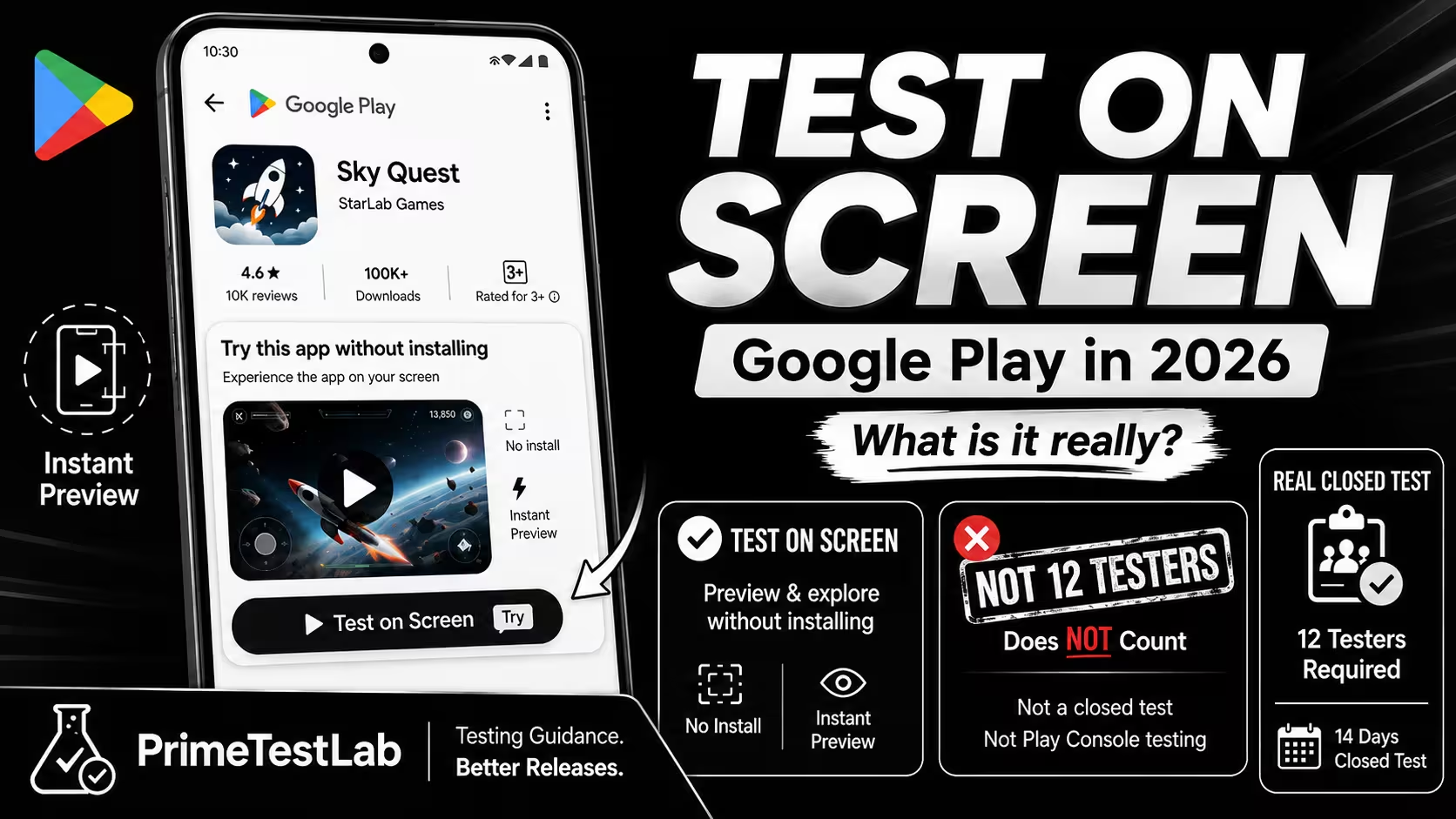
As of August 13, 2026, no official Google page located in this research uses “Test on Screen” as the name of a general Google Play feature. Google does, however, document one current no-install experience: the Play Store v51.0 release note dated April 13, 2026 says “you can now play some games on the You tab with no install required.” Google has not said that this You tab experience is called Test on Screen, and it has not published its eligibility criteria, architecture, session duration, developer setup path or Play Console metric definitions. Google Play Instant is separate and was discontinued through Play in December 2025. Game Trials also differ, because they install selected paid games before allowing up to 60 minutes of free play. Play Shorts is documented as video discovery. None of those interactions, by itself, establishes a qualifying closed-test opt-in: affected personal developer accounts still need at least 12 testers continuously opted into a closed test for 14 days before applying for production access.
Blocked by the closed test itself rather than by a Play Store button? PrimeTestLab staffs the documented requirement: 12 real testers, 14 continuous days, from $19.99.
See pricingBefore you change anything
- Blocked on production access? Nothing on this page gives you a documented shortcut around closed testing. Focus on the requirement Play Console actually shows for your account.
- Saw a game play without installing? That is most likely the documented You tab behaviour. It is real, and it is covered in its own section.
- Saw something else? Do not change your app architecture yet. Record the exact label, where in the Play Store it appeared, the Play Store version, device and country.
How this post grades every claim
Verified straight from a current Google or Android Developers page. Inference our reasoning, defensible but not published by Google. Community repeated developer reports, useful for orientation and never for policy. Unverified we looked and found nothing, which does not make the opposite claim true. Grades are attached to individual sentences, not sections, so you can see which words are load-bearing.
Most pages that answer this question get it wrong in one of two directions. The confident ones describe a lightweight instant experience with a “Try now” button, which accurately described Google Play Instant and is stale in 2026, because Google says Play stopped serving Instant Apps in December 2025. The cautious ones assume any “Try” button must be the 60-minute trial they read about, which belongs to Game Trials and comes after the game is installed. Both errors come from the same habit: treating separate Google systems as one idea. Every date and figure below was checked against Google's own pages on August 13, 2026.
What changed in this version, and why we are telling you
The first version of this article, published August 9, 2026, answered “can you try a Play app without installing it?” with “historically yes, currently no.” That was wrong for games. Google's Play Store v51.0 release note of April 13, 2026 documents no-install games in the You tab, and our original sweep never searched Play Store release notes at all. The finding about the name is unchanged; the answer about the behaviour is corrected throughout, and the source-class list is now published so you can audit it.
Key takeaways
-
01
As of August 13, 2026, no official Google source located in this research documents a general Play Store feature under the exact name “Test on Screen.” Unverified
-
02
Google does document a current no-install experience: Play Store v51.0, April 13, 2026 — “you can now play some games on the You tab with no install required.” Verified
-
03
No located source connects that You tab behaviour to the reported name, or publishes its eligibility, architecture, session length or developer setup path. Unverified
-
04
Google Play Instant is not the current explanation (Play stopped serving Instant Apps from December 2025), Game Trials install the paid game before its 60 free minutes, and Play Shorts is documented as video. Verified
-
05
None of these interactions, on its own, establishes a qualifying closed-test opt-in. Affected personal accounts still need 12 testers opted in for the last 14 days continuously before applying for production access. Verified
Is “Test on Screen” an official Google Play feature?
No official Google page located in this research uses that name for a general Play Store feature. That is a statement about the evidence, not proof the interface does not exist. It is also narrower than it sounds, and the distinction matters: Google has documented a current no-install experience for some games. It simply has never attached this name to it.
Read that carefully, because most articles blur it. Our source sweep did not locate documentation for the name is not the claim that the feature does not exist, that you did not see what you saw, or that a screenshot is fake. An undocumented label could be experimental, regional, or an interface string that never ships. This page has no primary evidence establishing any of those explanations either, so they are offered as possibilities rather than findings.
Confirmed vs not confirmed, question by question
| Question | Best evidence-based answer | Status |
|---|---|---|
| Is “Test on Screen” an officially documented Google product name? | No source located uses that exact name for a Play Store feature. | Unverified |
| Can any current Play Store surface run something without installing it? | Yes, for some games. Google: “you can now play some games on the You tab with no install required.” | Verified |
| Is that You tab experience called “Test on Screen”? | No located source connects the name to it, in either direction. | Unverified |
| Does the same no-install path exist for ordinary apps? | Google's note covers some games on one surface. No general equivalent for apps was located. | Not located |
| Is Google Play Instant still available through Play? | No. Google says Play stopped serving Instant Apps starting December 2025. | Verified |
| Is Game Trials the same thing? | No. Game Trials install selected paid games and allow up to 60 minutes of free play. | Verified |
| Is Play Shorts the same thing? | No evidence of that. Google documents Play Shorts as short-form video. | Verified distinction |
| Does any of this count as an install? | Google has not defined install accounting for the You tab sessions or for the reported name. | Unverified |
| Does any of it count toward 12 testers / 14 days? | No source says it does. None of these interactions alone establishes a closed-test opt-in. | Unverified |
The most important editorial line on this page
Do not turn an absence of documentation into the opposite claim. “We could not locate an authoritative source for the name” and “Test on Screen does not exist” are different statements, and only the first is supported. The reverse error is now equally available: a documented no-install game session is not evidence that the name is real.
The seven things nobody can answer yet
These are not hedges. Each is a question competing articles answer with total confidence and zero citation. Two questions that used to sit on this list — whether anything currently runs without installing, and whether a no-install path exists at all — came off it on August 13, 2026, because Google answered them.
Unknown as of August 13, 2026
- 01Whether the name refers to the You tab games. Plausible, and completely unsourced in both directions.
- 02Eligibility. Google's note says “some games.” Which ones, by what criteria, in which countries, is not published.
- 03Technical architecture. Nothing documents whether these sessions run locally, remotely, or how. Never write “streamed” without a source.
- 04Session duration. No documented time limit for the You tab games. The 60-minute figure belongs to Game Trials and is not transferable.
- 05Install accounting. “No install required” describes the user experience. It does not define how the session appears in installs, acquisition, reach, active users or install base.
- 06Developer opt-in. No Play Console switch, setting or navigation path has been located for enabling or disabling any of it.
- 07Closed-testing interaction. Nothing connects any of it to the production-access gate. This is the one that costs money, so it gets its own section.
Why searching the name does not work
“Test on screen” is an ordinary English phrase that already had an owner: dozens of Android utilities that check for dead pixels, touch response and display faults, with years of ranking behind them. Searching it returns hardware diagnostics, not a Play Store feature. Searching the behaviour is the instrument that works — “no install required” against Google's release-notes corpus returns the April 13, 2026 entry immediately, and that is the query class this page's first sweep never ran. All eight source classes and the exact queries are published in section 09 so you can repeat the sweep rather than trust ours.
What are the no-install games in Google Play's You tab?
They are the clearest current Google documentation of a no-install Play Store experience — and they are one sentence long. Google's Play Store v51.0 release note, dated April 13, 2026 in the Google System Services release notes, says users can now play some games on the You tab with no install required. That is the entire published record. Verified
Google's exact wording, quoted in full
“You can now play some games on the You tab with no install required.”
Google System Services release notes, Google Play Store v51.0, entry dated April 13, 2026. Accessed August 13, 2026. Verified
Quoted in full, because the full quote is short enough to fit and because almost every mistake available here comes from paraphrasing it into something larger. Note what the sentence contains: a capability, a surface, and a qualifier. Note what it does not contain: a product name, a list of eligible titles, a session limit, an execution model, a developer setup path, or a reporting definition.
What this source does and does not establish
It establishes
- Google Play currently offers a no-install experience for some games
- The surface is the Play Store's You tab
- It shipped in Play Store v51.0, noted April 13, 2026
- It is narrower than the former general Play Instant platform
It does not establish
- That Google calls it “Test on Screen”
- That every app or game is eligible
- That it uses the former Play Instant architecture
- Any session duration
- That developers can enable it through Play Console
- Any install, acquisition or reach metric behaviour
- Anything at all about closed testing
So the defensible formulation, and the one this page uses everywhere: “Test on Screen” remains an unverified product name, Google does document a current no-install gaming experience in the Play Store's You tab, and no located source connects the two. All three clauses are load-bearing. Dropping the first produces a fabricated product; dropping the second is the error the August 9 version of this page made; dropping the third invents a link nobody has published.
If you are a developer reading this hopefully
There is nothing to implement. No Play Console setup path, eligibility form or developer-facing documentation was located for the behaviour in that release note. Do not rebuild, repackage or reconfigure an app around it, and be especially wary of advice that hands you Play Instant's old 15 MB ceiling or manifest requirements as though they carried over. They belong to a service Google shut down. No developer documentation located
Where the You tab came from
The You tab is a Play Store surface that collects your subscriptions, rewards, achievements and in-app progress. Google has been adding to it through 2026 — the same release-notes stream records a Gamer Profile arriving there in v51.0 and Play Games Leagues in v50.9. The no-install games note sits in that sequence, which is a reasonable indication it is a games-and-profile feature rather than a testing feature. That reading is ours, not Google's. Inference
Can you try a Google Play app without installing it?
Yes, but only in a limited documented form. Google's April 13, 2026 Play Store release note says users can play some games on the You tab with no install required. Verified Google has not published a general equivalent for ordinary apps, and it has not identified that You tab experience as “Test on Screen.” Unverified Google Play Instant is separate and was discontinued through Play in December 2025. Game Trials are separate too, because they install selected paid games before the trial begins.
Sources: Google System Services release notes (Play Store v51.0, April 13, 2026) and Google's Play Instant overview, which carries the deprecation notice. Accessed August 13, 2026.
This is the question almost everyone is really asking, and it has the most stale content attached to it anywhere on this topic — because Play Instant worked for roughly seven years and generated a decade of tutorials nobody went back to date-stamp. It is also the question this article got wrong on first publication, in the opposite direction: by August 2026 the honest answer was no longer a flat “not any more.”
“Is there a way to test app online without installing first on the phone?”
Quoted verbatim from Reddit, r/googleplay · October 2024 Community
How Play Instant worked, while it worked
Worth keeping because it is the thing most articles are still describing, and because knowing its shape is how you recognise a stale page. Google's documented sequence: the user tapped Try now on the store listing, Play sent the necessary files to the device, and — in Google's own words — “the device then runs the app or game.” Execution was local, the experience had to come in under 15 MB, and an optional full install could follow. Verified, historical
Two things follow from that sentence about local execution. First, it rules out describing Play Instant as streaming. Second, it says nothing whatever about any other surface — so it cannot be used to explain how the You tab games run. That remains undocumented, and neither can the 15 MB ceiling be carried across to them.
The one documented no-install path. Which games, for how long and by what mechanism are all unpublished.
Ran across the catalogue rather than one surface. Cannot be published, APIs dead, no longer served to users.
No current Google documentation locates a no-install path for them. That part of the old answer still holds.
Why you may still be reading contradictory things
There is a genuine inconsistency inside Google's own web presence, and naming it explains a lot of confusion.
Consumer help, apparently stale
“Use apps without installing them”Consumer-facing Play help text describing apps you can use without installing was still surfacing in our August 13, 2026 sweep. It reads as current because Google published it and never obviously retired it. Inference
Developer docs, specific and dated
“Users will no longer be served Instant Apps by Play”The Android Developers deprecation notice is more specific, more recently updated, and states a date. When two Google pages disagree about a service's status, the dated and specific one wins.
The rule worth applying yourself: a dated deprecation notice on Android Developers outranks undated consumer help copy about the same service. But note the limit of that rule, which the first version of this page ran past. It resolves a conflict about Play Instant. It does not license the further step of concluding that no no-install path exists anywhere — that conclusion needed its own sweep, and the sweep was incomplete.
If what you actually want is to test your own app
Developers asking “can I test an app without installing it” usually want something different from consumers: a way to run their own build without wiring up a device. That is a different problem with real answers — Android Studio's emulator, Play Console's internal testing track with up to 100 testers, or the pre-launch report. None is a consumer preview feature, and internal testing specifically does not satisfy the closed-test requirement for production access.
Is it Google Play Instant?
No source connects them, and the structural facts make a rebrand claim harder rather than easier. Google explicitly discontinued Play Instant through Google Play in December 2025: it can no longer be published through Play, the service APIs no longer work, and users are no longer served Instant Apps. Verified Google's public documentation describes a shutdown rather than a rename, and no located source connects that retired surface to either the reported label or to the current You tab no-install games. Unverified
The common claim
“It's just Play Instant, rebranded”Superficially tidy. Google had a try-before-install feature, Google appears to have a try-before-install feature again, so one must be the other under a new label.
What the sources support
A shutdown, and an unconnected new surfaceThe record describes Play Instant being retired, and separately describes some You tab games playing without an install. Nothing published joins the two. A rebrand claim needs a source that does not exist.
Why the rebrand story does not hold up
A rename leaves the machinery running. Google's notice does the opposite: publication through Play stopped, the Play Instant service APIs stopped working, and users stopped being served Instant Apps. That is a shutdown, and the documentation describes it as one. Verified
Play Instant was a general platform: developers built instant experiences, published them, and users could reach them from ordinary store listings across the catalogue. What Google documents now is narrower by its own wording — some games, on one surface, with no developer-facing publishing path located at all. Those are different shapes, whatever either is called. Verified
Accept the rebrand story and you also inherit its numbers: the 15 MB ceiling, the instant-app manifest requirements, the old Play Console configuration. Applying any of those to a surface Google has not specified is how a confident article becomes a wrong one. Unverified
At I / O 2026 and in the Q2 2026 Play update, Google named Play Shorts, Ask Play, Gemini-powered discovery and Game Trials. We read that pattern as making a silently relaunched instant-app platform unlikely. That is our inference about Google's communication habits, not a Google statement, and it is the weakest argument in this section — discount it accordingly. Inference
Long before anyone searched this feature name, developers were filing the same confusion in a different form: “Try Now button is not visible” on an internal test track (July 2024), “Try Now button disappears” on a published listing (November 2024), then r/androiddev registering the discontinuation (June 2025). The surface was inconsistent for a year before it formally ended, which is why so much published advice about it went stale without anyone noticing. Community sources are used here to show what developers experienced and when, never to establish policy. Community
The hypothesis this page will not rule out
It remains entirely plausible that what you saw is the You tab games feature under an interface label Google never documented, or a limited experiment, or a regional A/B test. Google runs Play Store experiments continuously and documents very few of them. Those are reasonable things to believe; they are just not things anyone can currently source, which is why they appear here as hypotheses and never as findings.
Is it Game Trials or Play Shorts?
Both are real, both are current, and neither is a no-install preview of an ordinary app. On a selected paid game, a Try button means Game Trials: the game installs, then you get up to 60 minutes of free play. Play Shorts is a short-form video feed. Google documents it as video and does not describe it as running or installing the featured app. Verified
Game Trials: the six facts that identify it
Google announced Game Trials on March 11, 2026 for select paid games. The step that surprises people is the second one.
-
01
Selected paid games only
Not the whole catalogue, and not free apps. The listing shows a Try button beside the usual purchase control.
-
02
Tap Try, and the game installs
This is what separates Game Trials from every no-install path: Google's own description is that the feature lets you install and play paid games. An Android package lands on your device.
-
03
First launch starts the timer
Not install, not download, not purchase. The clock begins when the game is first launched.
-
04
The timer keeps running if you close the game
Closing it does not pause anything. The 60 minutes is wall-clock time, not accumulated playtime.
-
05
Up to 60 minutes, free
Sixty minutes is the documented maximum for Game Trials specifically, and it belongs to Game Trials only.
-
06
Buy it, and your progress carries over
Purchasing unlocks continuation, and Google states that trial progress carries into the purchased game.
Source: Google's March 11, 2026 paid-games announcement and the Game Trials description in Play Console. Accessed August 13, 2026. Verified Paid-game developers who need the full requirements list (bundle format, Play App Signing, API 21+, supported device classes, and where to enable it) should read that Console page directly rather than a summary here — Console navigation labels and rollout defaults change quickly.
The 60 minutes is not portable
This is the most frequently misapplied number in the whole topic. Sixty minutes is a documented property of Game Trials. It is not a Play Store-wide session limit, it was never a Play Instant rule, and there is no basis for attaching it to the You tab games or to an undocumented surface. If an article gives “Test on Screen” a 60-minute limit, it has borrowed that figure from a different product.
Play Shorts: what Google actually says
Google describes Play Shorts as a full-screen, portrait, short-form video feed that gives users a glimpse of an app's look, feel and functionality, announced at I / O 2026. Verified
The careful conclusion, and the only one the source supports: Google documents Play Shorts as short-form video and does not describe it as running or installing the featured app. That is enough to separate it from every mechanism on this page. Stronger claims — that nothing executes, that nothing is installed, that no data moves — go beyond what Google published. A company documenting a video feed is under no obligation to publish a negative statement about every possible background behaviour, and treating its silence as a specification is the same error this article exists to avoid.
A full-screen, portrait, short-form feed for app discovery. Announced at I / O 2026.
Google's description does not present it as an execution environment. That is a statement about the documentation, not about the architecture.
Watching a video is not an opt-in event, so it cannot by itself establish a qualifying closed-test enrolment.
Use the names as a filter on other articles
Check which names a page uses. One that says “Try now” is describing Play Instant and is stale unless it dates the December 2025 shutdown. One that says “60 minutes” is describing Game Trials and owes you the word install in the same sentence. One that says “streamed” is describing nothing Google has published. And one that says no-install previewing ended with Play Instant has missed the April 13, 2026 release note — as this article did until August 13, 2026.
Compare the five possible mechanisms
Five separate things, one blurred search term. Four have current Google documentation, one does not. This table is the reference version; the tool underneath turns the same information into an answer about the specific thing you saw.
| Mechanism | Current status | Installs first? | Official name? | Main documented purpose |
|---|---|---|---|---|
| Reported “Test on Screen” | Unverified | Unknown | No source located | Unknown |
| You tab no-install games | Current | No ordinary installation required | No separate name in the release note | Let users play some games from the You tab |
| Google Play Instant | Discontinued through Play, Dec 2025 | No conventional install | Yes | Historical friction reduction before install |
| Game Trials | Current, announced Mar 11, 2026 | Yes | Yes | Try selected paid games before purchase |
| Play Shorts | Current, announced at I / O 2026 | Not applicable | Yes | Video discovery |
One row deserves re-reading. The You tab entry says no separate name in the release note rather than “no name”: Google described a behaviour without branding it. That is why this article cannot tell you whether the label you saw belongs to it, and why it will not guess. None of the five, on its own, establishes a qualifying closed-test opt-in.
Which one did you see? Identify it from four signals
Labels move; behaviour and location are more stable. Answer four questions about what you observed and the tool resolves them against Google's published descriptions. Nothing is sent anywhere — the logic runs entirely in your browser, and the tool tells you when it cannot settle the question.
Play Store feature identifier
Four observable signals, resolved against Google's own descriptions of the You tab games, Play Instant, Game Trials and Play Shorts.
1 Where in the Play Store did you see it?
2 What did the control say, or look like?
3 Afterwards, did an app package appear in Settings › Apps?
4 Was it a game, and was it paid?
Resolved against Google's Play Store v51.0 release note (April 13, 2026), the Play Instant deprecation notice, Play Console's Game Trials description and the I / O 2026 Play announcement, all accessed August 13, 2026. It reports the closest documented match, not a certainty.
What the package check can and cannot tell you
An ordinary installed package is strong evidence of an installation-based flow — it is how you rule Game Trials in and a no-install path out. But it does not by itself reveal the complete architecture of an undocumented experiment, and its absence is weaker still: you checked a settings screen, which is not the same as auditing what the device did. That is why this tool now weighs location alongside the package check rather than treating either as decisive.
Does it count as an install?
Unknown, and that cuts both ways. Google has not published install-accounting definitions either for a feature under the reported name or for the You tab no-install game sessions. So do not state that any of it increases your installs, do not state that it never touches them, and do not assume it appears in or is excluded from any particular Play Console metric until Google defines the event.
The two-directional refusal matters more here than anywhere else on this page, because most writers who reach this question pick a side and both sides are equally unsupported.
Unsupported claim A
“It inflates your install numbers”Sounds cautious, reads as insider knowledge, has no source. Nobody has published what event, if any, these sessions emit.
Unsupported claim B
“Google said no install, so nothing is counted”This one now has a real quote attached to it, which makes it more dangerous rather than less. Read the sentence again.
“No install required” is a user-experience statement, not a metric definition
Google's April 13, 2026 release note tells a user they do not have to install anything. It says nothing about how the resulting session is recorded in a developer's Play Console: not whether it appears in acquisition reporting, not whether it touches reach, active users or install base, and not whether it is excluded from everything. Those are separate systems decided separately inside Google, and the release note does not address them. Treating a consumer-facing sentence as a reporting specification is the single most likely way to misuse the source this article was corrected to include. Not documented
Google's Q2 2026 Play update is the natural place a new developer metric would be announced. It highlights a new reach metric and AI-assisted reporting, and no metric named after the reported feature or the You tab sessions was identified in it. Not located That absence is informative but limited: Google is under no obligation to expose an experiment's events to developer reporting at all.
You can get a real answer for your own app, and it is worth stating the method precisely because a sloppy version produces confident nonsense: read your exact acquisition, install and active-user baseline first (with Play Console's date range and time zone), change exactly one thing (one device, one account, one session), wait out the reporting lag rather than refreshing an hour later, and then report the result as an observation about your app on that Play Store version — not as a metric definition.
Whatever any of this does to your reporting, it has no bearing on the requirement in the next section. Install counts and closed-test opt-ins are separate things in Play Console, and only one of them decides whether you can apply for production access.
Does it count toward the 12-testers requirement?
No official Google source located says that any of it does — so do not plan around it. Google's documented production-access condition is a closed-test opt-in: at least 12 testers opted into your closed test for the last 14 days continuously. No located source says a preview, a video, a Game Trial, a You tab no-install game session or a reported on-screen session substitutes for that opt-in.
This is the question that arrives in our inbox in a dozen phrasings every week, usually from someone who has found a shortcut and wants confirmation before betting two weeks on it. The answer has never changed, and the reason is structural rather than technical: the requirement is defined by an enrolment event in a specific track, not by someone having experienced your app.
The condition, as Google states it
At least 12 testers must be opted in to your closed test, and they must have been opted in for the last 14 days continuously at the point you apply. Applies to qualifying personal developer accounts. Meeting it lets you apply for production access; Google says that review usually takes 7 days or less, though it can take longer. Verified
Source: Play Console Help, closed testing requirements for new personal developer accounts. Accessed August 13, 2026.
What establishes the opt-in, and what does not
| Action | Does it establish a qualifying opt-in? | Why |
|---|---|---|
| A tester opts into your qualifying closed test and stays opted in for the required period | Yes — this is the documented condition | Google specifies at least 12 opted-in closed-test testers for the last 14 days continuously. |
| Internal testing | Not on its own | A separate track. The production gate specifies a closed test, whatever the internal tester count reaches. |
| Someone watches a Play Short | Not on its own | Play Shorts is a video discovery format. Watching video is not a track enrolment event. |
| Someone plays a Game Trial | Not on its own | Game Trials documentation describes free trials of paid games and says nothing about production-access closed testing. |
| Someone plays your game from the You tab with no install | Not on its own | Google's April 13, 2026 release note describes a way to play. It documents no relationship to any testing track. |
| A historical Instant App “Try now” session | No current route — the service ended | Google stopped serving Instant Apps through Play in December 2025, so this is not available to attempt. |
| A reported “Test on Screen” session | Unknown — do not count on it | No official connection to the production-access requirement was found in any located source. |
| A store-listing impression | Not on its own | The required event is an opt-in to the closed test, not exposure to the listing. |
Read those middle rows precisely. They say the interaction alone does not establish a qualifying opt-in — not that the person is disqualified. Somebody can play a Game Trial or a You tab game and separately be enrolled in your closed test. The activity simply is not itself the enrolment event that the requirement measures.
Check your own position against the documented condition
Enter what Play Console is currently showing you. The tool applies the published rule and nothing else. It starts empty on purpose: an earlier version of this page loaded pre-filled with a qualifying example and displayed a success verdict before anyone had typed anything.
Production-access qualification checker
Resolved against Play Console Help's current closed-testing requirement for new personal developer accounts.
1 What kind of developer account publishes this app?
2 Was that account created after November 13, 2023?
3 Does Play Console actually show you this production-access testing requirement?
4 Which track are your testers in?
That is one question rather than two on purpose. Testers opt in on different days, so a headline count beside a headline day number can both look right while no twelve people share a continuous 14-day window.
Applies the published condition only: 12 testers opted in to a closed test, each held continuously for 14 days. It cannot see your Play Console and does not predict Google's decision.
Three things worth knowing about the requirement itself
Continuity is what breaks, not daily opens. Google's wording is framed around testers being opted in for the continuous period; the located policy text sets no per-day install count and no once-per-day launch rule. What can cost you eligibility is someone opting out, leaving the Google Group or switching account mid-window. Recruiting late moves the finish line rather than shortening it. Verified The 12-testers guide covers installs and daily usage in depth.
Internal testing is not a substitute. It supports up to 100 testers, which makes it look like the more generous track, but Google requires the qualifying test to be a closed test. Internal testing stays valuable for fast quality assurance; it simply is not the test this gate asks for. Verified
Account type decides whether the gate applies at all. Google documents this additional production-access testing requirement for personal developer accounts created after November 13, 2023. Organization is a separate account type. Confirm the requirement actually shown in your Play Console rather than relying on an inferred exemption — the operative fact is what Console displays for the account you publish under, not the category you believe you fall into. Verified as scoped The account-type comparison is here.
How to record what you saw
Preserve evidence, and do not restructure anything around an undocumented surface. There is no Play Console switch to flip and no eligibility box to tick, because none has been documented — not for the reported name, and not for the You tab no-install games either. What there is: a way to record a sighting so it is worth something later, and a way to re-run the evidence check yourself.
The fields that make a sighting count
A screenshot on its own settles very little. A screenshot plus context can genuinely establish what a surface is, where it appears, and whether it behaves like any documented mechanism. Since April 13, 2026 the location field carries more weight than the button text, because the one documented no-install path is defined by its surface rather than by a label.
Capture at the moment you see it
- Where in the Play Store it appeared — You tab, a store listing, Games tab, search, a link. The highest-value field
- The exact button text, character for character, including capitalisation
- A screenshot of the full screen, not a crop of the button
- The Play Store app version from Play Store settings — the field most often missing
- Device model and Android version
- Country and Google account type (personal, Workspace, child account)
- The app, its package name, its category, and whether it is a paid game
- Whether it was previously installed on that device or account
Capture after you tap it
- Whether any download progress appears, and roughly how large
- Whether an Android package appears in Settings › Apps afterwards
- How long the session stays usable, measured, not estimated
- What happens when you close and reopen it
- Which Play Console metrics move, if it is your own app, against a baseline you read first
- The date and time, with time zone
- Whether you can reproduce it on a second device or account
Label it as an observation, not as Google
Anything you record firsthand is an observation on one device, one account, one country and one Play Store version. Write it that way: “Observed on [surface / device / Play Store version / country / account / date]”. Never convert a single sighting into a claim about global eligibility or rollout — that is precisely the mistake that fills the search results this page had to work around.
Observation recorder
Fill in what you know, leave the rest blank, and copy the result. It produces a properly labelled report you can paste into a bug tracker, a forum post, or an email to us. Nothing is transmitted — the text is assembled in your browser and never leaves it.
Turn a sighting into a checkable record
A compact subset of the evidence fields above, formatted as a dated, correctly hedged observation report.
1 Where in the Play Store did it appear?
2 Did an app package appear in Settings › Apps afterwards?
3 Could you reproduce it on a second device or account?
Fill in any field above to build the report.
Generated locally. The report records only what you saw — it deliberately carries none of this article's research conclusions, because those are dated and would go stale wherever you paste it.
How to describe this without being wrong
| Topic | Safe factual wording | Wording to avoid |
|---|---|---|
| The name | “A UI described as Test on Screen has been reported, but we could not locate Google documentation under that exact name.” | “Google has officially launched Test on Screen for all apps.” |
| No-install play | “Google documents that some games can be played on the You tab with no install required, as of April 13, 2026.” | “You can now try any Play Store app without installing it.” |
| The link between them | “No located source connects the reported name to the You tab behaviour.” | “Test on Screen is the You tab no-install feature.” |
| Architecture and duration | “Google has not documented the execution model or any session limit for these sessions.” | “It is streamed, and sessions last 60 minutes.” That figure belongs to Game Trials. |
| Install accounting | “How these sessions appear in Play Console reporting is not documented.” | “No install means it is not counted anywhere.” |
| Closed testing | “No Google source says any of these interactions alone establishes a qualifying closed-test opt-in.” | “Use Test on Screen instead of closed testing.” |
Re-run the evidence check yourself
This page's central finding has an expiry date attached to it by nature. One Google publication changes the answer. Copy these queries and run them — and note that the last three search for the behaviour rather than the name. That is the lesson of this article's own correction: name-shaped queries returned screen-diagnostic apps for four months while a behaviour-shaped query found Google's release note immediately.
"Test on Screen" "Google Play"
site:support.google.com/googleplay "Test on Screen"
site:developer.android.com "Test on Screen"
site:support.google.com/product-documentation Play Store no installation games
site:support.google.com/product-documentation "You tab" games
site:support.google.com/product-documentation "no install required"
Source classes worth sweeping, in the order that has actually produced results: Google System Services release notes, Play Store version release notes, Google Play consumer help, Play Console Help, Android Developers, Google Play announcements, then exact-name web search last. Then check the surface on at least two devices or accounts before concluding anything about rollout.
Where PrimeTestLab fits, and where it does not
Start with the boundary, because it is the whole reason this section is credible: no service can make a Play Store preview count toward your closed test. Not us, not anyone. If a provider tells you they have a way around the 14 days, they are describing something Google does not document either. What we do is narrower and duller: we staff the requirement that is documented — 12 real testers, opted in for 14 continuous days.
The reason this post exists on a closed-testing site is the inbox. The message arrives in a dozen phrasings — does this new button count, can my testers just use the preview, I saw a game open without installing — and underneath all of them is the same hope: that fourteen days of calendar time can be replaced by something clever. It cannot. The gate is an enrolment event held continuously, and the only thing that satisfies it is people who are actually enrolled.
Google decides production access. No service can influence that decision, and this page will not pretend otherwise. What a managed test removes is the recruitment and continuity risk, which is the step most first-time publishers actually stall on. Success rate across 9,800+ apps tested: 99.9%, in 120+ countries.
And if you write in with a screenshot of a surface we cannot identify, you will get an honest answer about what it probably is, a suggestion to record it properly, and no invoice attached to the reply. The commercial part of our business is the 14 days — and the 14 days are not something a preview can shorten.
Frequently asked questions
What is Test on Screen on Google Play?
As of August 13, 2026, this research could not locate an official Google help page, developer announcement or release note defining a general Google Play feature under the exact name Test on Screen. Treat the label as unverified or potentially experimental until Google publishes documentation, or until a reproducible Play Store observation establishes what it does. That is a statement about the available evidence, not proof that no such interface exists.
Can I try a Google Play app without installing it first?
Yes, but only in a limited documented form. Google's Play Store v51.0 release note, dated April 13, 2026, says you can now play some games on the You tab with no install required. Google has not published a general equivalent for ordinary apps, and it has not identified that You tab experience as Test on Screen. Google Play Instant is separate and was discontinued through Play in December 2025. Game Trials are separate too, because they install selected paid games before the trial begins.
What are the games I can play from the You tab without installing?
Google's April 13, 2026 Play Store release note says some games can be played on the You tab with no install required. That single sentence is the entire published record. Google did not provide a separate public product name in that note, and it did not publish an eligibility list, a session limit, a technical specification or a developer setup path alongside it.
Is the You tab no-install experience called Test on Screen?
No official source located connects the two. The release note verifies the no-install behaviour but not the Test on Screen label, and nothing published rules the connection out either. Treat a link between them as possible but unverified, and do not repeat it as though Google had confirmed it.
Can developers enable You tab no-install games?
No public Play Console setup path or developer eligibility documentation was located for the behaviour described in that release note. Do not rebuild or reconfigure an app around it unless Google publishes developer-facing instructions, and be especially careful of advice that applies Google Play Instant's old 15 MB ceiling or manifest requirements to it, because those belong to a service Google shut down in December 2025.
Does playing a You tab game count as an install?
The release note says no installation is required, but that describes the user experience rather than the reporting. It does not define how the session appears in Play Console acquisition, install, reach, active-user or install-base metrics. Do not assign it to a metric, or assume it is excluded from every metric, without additional Google documentation.
Is Test on Screen just Google Play Instant with a new name?
No source located connects them. Google's public documentation describes a shutdown rather than a rename: from December 2025 Instant Apps can no longer be published through Play, the service APIs no longer work, and users are no longer served Instant Apps. Nothing published links that retired platform to either the reported label or to the current You tab no-install games, so a rebrand claim remains unsupported.
What is the Try button I see on some paid games?
That is most likely Game Trials, which Google introduced on March 11, 2026 for select paid games. Game Trials let users install an eligible paid game and play at no charge for up to 60 minutes, with the timer starting at first launch and continuing even if the game is closed. Progress carries over if they buy it. Note that the game does install — this is not a no-install preview.
Does Test on Screen count as one of my 12 closed testers?
No official Google source located says that it does. Google's production-access condition is at least 12 testers opted into your closed test for the last 14 days continuously, so use the closed-testing opt-in workflow rather than relying on a preview, a trial or a You tab session. The requirement is defined by an enrolment event in a specific track, so none of those interactions on its own establishes a qualifying opt-in — though a person could of course do one of them and separately be enrolled in your closed test.
Is internal testing enough instead of the 12-person closed test?
No, for accounts subject to the production-access requirement. Internal testing supports up to 100 testers, but Google requires the qualifying test to be a closed test. Internal testing remains useful for fast quality assurance; it is simply not the test this gate asks for.
Is it still 20 testers or is it 12 now?
It is 12. Google announced the original 20-person requirement on November 9, 2023, scoped to relevant personal accounts created after November 13, 2023. That announcement now carries a visible December 11, 2024 update recording the reduction to 12, made after developers reported how difficult finding 20 testers had been. Both the number and the change date are documented on Google's own post.
How long does Google take after the 14-day test?
Completing the threshold lets the developer apply for production access, not automatically receive it. Google says that review usually takes 7 days or less, although it can occasionally take longer. No number of testers guarantees approval, and no service can influence the decision.
How much does PrimeTestLab cost if I need real testers for closed testing?
PrimeTestLab offers three plans: Starter with 12 testers for $19.99, Professional with 20 testers for $29.99, and Enterprise with 25 testers for $27.99. All plans use real testers on real devices for the full 14 day period, testing typically starts within 4-6 hours, and if a test does not deliver you get a free retest or a full refund.
Bottom line
Summary
As of August 13, 2026, no official Google page located in this research uses “Test on Screen” as the name of a general Google Play feature. That is an evidence finding, not proof that no such interface exists. Google does document one current no-install experience: its Play Store v51.0 release note of April 13, 2026 says users can play some games on the You tab with no install required — without naming it, or publishing its eligibility, architecture, session length, developer path or metric behaviour. No located source connects that behaviour to the reported name. The rest stays as it was: Google Play Instant did run apps without a conventional install and Play stopped serving it from December 2025; Game Trials, announced March 11, 2026, installs a selected paid game and then allows up to 60 minutes of free play; and Google documents Play Shorts as short-form video without describing it as running or installing the featured app. None of these interactions, on its own, establishes a qualifying closed-test opt-in: affected personal accounts still need at least 12 testers opted into a closed test for the last 14 days continuously before they can apply for production access, with Google's review usually taking 7 days or less. If the closed test is what is actually blocking your launch, PrimeTestLab supplies 12 real testers from $19.99. See pricing plans →
What would make this page wrong
Every article about an unverified subject should publish its own failure conditions. These are ours, ranked by how fast they could bite — and the first one is on the list because it already happened once.
The August 9, 2026 version of this page searched Play Help, Console Help, Android Developers and Google's announcements, and never searched Play Store release notes at all. That is where the April 13, 2026 no-install games note was sitting, four months old, while this page displayed a four-day-old freshness stamp and the wrong answer. The source-class list is now published precisely so the next gap is visible rather than invisible.
A help page, a Console entry, a release note or an announcement replaces this page's central finding outright — trust Google's page, not this one. The single largest open question is whether the reported label refers to the documented behaviour, and one Google sentence resolves it in either direction. This article is deliberately built so that sentence can be dropped in without the rest needing a rewrite.
Everything published about it is one sentence in a release note. Eligibility, session length, an architecture, a Console path or a metric definition would each change several sections here. So would it quietly disappearing, which release-note features sometimes do.
The minimum has already gone from 20 to 12 once, on December 11, 2024; any change to the 12 testers or 14 continuous days means re-reading every section that cites them. Separately, the 60-minute Game Trials figure could move, and deprecated Play Instant documentation gets removed eventually.
Every primary source behind this page
Evidence checked: August 13, 2026. This page's central finding is a dated absence, which is the most perishable kind of claim there is — a single Google publication can overturn it, and one nearly did without us noticing. The exact queries and the full list of source classes behind it are published in section 09 so you can repeat the sweep yourself rather than trusting ours. If you find a Google source we missed, it outranks everything written here.